
Downy mildew of poppy
Peronospora somniferi
The disease is caused by the oomycete Peronospora somniferi, an obligate parasite specifically targeting plants in the Papaver genus. It is a highly specialized pathogen that relies on living host tissue to complete its life cycle.
What the section contains
Downy mildew of poppy
The pathogen overwinters as oospores, which are thick-walled resting spores capable of persisting in soil and crop debris for several seasons. When conditions become favorable in the spring, these oospores germinate to initiate primary infections.
The fungus develops internally within the host plant, forming a network of mycelium in the intercellular spaces. It utilizes haustoria, specialized structures that penetrate host cell walls to absorb nutrients directly from the cytoplasm.
Asexual reproduction occurs through the production of sporangia, which emerge from stomata under conditions of high humidity. These sporangia are easily dispersed by wind and splashing rain, leading to secondary cycles of infection.
Seed transmission is a critical aspect of this disease. Mycelium and oospores can be carried with or inside the seed coat, allowing the pathogen to be introduced into new fields or even different geographic regions.
Early symptoms appear as small, yellowish chlorotic spots on the cotyledons or first true leaves. These spots can rapidly expand and cover larger areas, eventually turning necrotic or brown as the tissue dies.
A diagnostic sign is the presence of a fuzzy, grayish to violet-gray mold on the undersides of the leaves, particularly during periods of high humidity. This is the visible mass of sporangiophores and sporangia.
As the infection progresses, leaves may curl, wither, and collapse. In severe cases, particularly in young seedlings, the pathogen can cause damping-off or total plant death, leading to significant thinning of the crop stand.
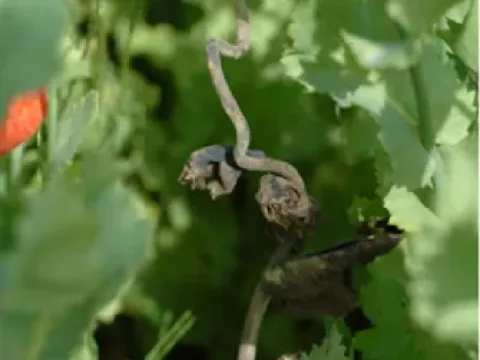
In mature plants, the disease can affect the stems and capsules. Infected stems may become deformed, twisted, or stunted, impairing the movement of water and nutrients to the developing seed heads.
The seed capsules themselves often show signs of infection, such as brownish discoloration or shriveling. Internally, the seed mass may become decayed, leading to significant reductions in seed quality and viability.
High relative humidity, typically exceeding 80%, is the primary environmental driver for Downy mildew development. Frequent rain events and heavy morning dews provide the necessary surface moisture for spore germination.
Cool to moderate temperatures, ranging between +15°C and +20°C, are optimal for the pathogen. In this temperature range, the disease cycle can repeat every few days, causing rapid spread across a field.
Dense crop stands create a microclimate with restricted airflow, which maintains high humidity levels for longer periods. This makes high-density plantings significantly more vulnerable to rapid disease outbreaks.
Continuous cropping of poppies on the same site allows for the accumulation of oospores in the soil. Without adequate crop rotation, the primary inoculum load increases every year, raising the risk of severe infection.
Poor soil drainage and low-lying areas in a field often retain moisture for longer periods, serving as localized hotspots for disease initiation and development within the poppy crop.
The most significant impact of Downy mildew is the substantial loss of yield, which can range from minor damage to complete crop failure in epidemic years. Reduced plant density is a major contributing factor to lower yields.
Photosynthetic efficiency is severely compromised by the destruction of leaf tissue. This lack of energy production results in smaller capsules and poor seed filling, significantly reducing the final weight of the harvested crop.
Seed quality is severely degraded, as infected seeds may be shriveled, discolored, or carry the pathogen, making them unsuitable for both processing and future planting purposes.
The disease weakens the overall vigor of the poppy plants, making them more susceptible to opportunistic secondary infections by other fungi or bacteria, further complicating the field's health.
Economic losses are compounded by the high cost of implementing intensive fungicide programs required to manage the disease, especially when weather conditions are conducive to persistent infection cycles.
The cornerstone of management is a strict crop rotation schedule, avoiding poppy cultivation on the same land for at least 3-4 years. This significantly reduces the levels of soil-borne oospores.
Using high-quality, pathogen-free seeds is essential. Seed treatment with appropriate systemic fungicides is a standard preventive measure to protect emerging seedlings from early-season soil-borne infections.
Field sanitation is critical; this involves the thorough incorporation or destruction of crop residues immediately after harvest to speed up the decomposition of infected material and reduce the inoculum reservoir.
In-season management requires regular monitoring and the timely application of foliar fungicides. Targeted sprays should be initiated as soon as environmental conditions favor the disease or when early symptoms are detected.
Promoting good airflow within the canopy through optimal plant spacing and effective weed control helps create a microclimate less conducive to the pathogen's sporulation and survival.