
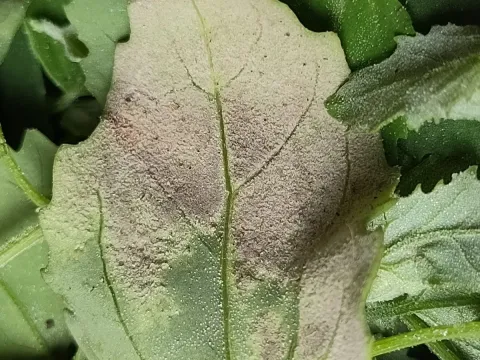
Downy mildew of spinach
Peronospora farinosa
The first symptoms of downy mildew appear as distinct yellow, chlorotic patches on the upper surface of the spinach leaves, often following leaf veins.
What the section contains
Downy mildew of spinach
When humidity levels are high, a dense, grayish-purple or bluish-white fuzz develops on the underside of the leaves, directly beneath the yellow spots.
As the disease progresses, the infected leaf tissue turns brown, becomes necrotic, and eventually dries out, rendering the leaves inedible.
In severe infections, the entire leaf rosette can show signs of wilting, yellowing, and deformation, leading to stunted growth of the plant.
Infected leaves become unsightly and completely lose their market value, making them unsuitable for fresh consumption or processing.
The disease is caused by the oomycete Peronospora farinosa f. sp. spinaciae, an obligate parasite that specifically infects spinach plants.
The pathogen produces oospores which allow it to survive in the soil for several years and serve as a primary source of inoculum for new plantings.
During the growing season, the fungus spreads via sporangia that are easily dispersed by wind, splashing rain, or irrigation water across the field.
The fungus colonizes the intercellular spaces of the leaf tissue, extracting nutrients through haustoria that penetrate the plant cells.
The existence of multiple pathogenic races makes the control of the fungus difficult, as it can evolve to overcome host plant resistance.
Downy mildew development is highly favored by cool temperatures, typically ranging from 10 to 20 degrees Celsius, and high relative humidity.
A period of leaf wetness lasting several hours, often caused by dew, fog, or overhead irrigation, is essential for the germination of the spores.
Dense plant canopies that restrict air movement keep the leaf surface wet for longer periods, providing an optimal environment for infection.
Poor soil drainage and high humidity levels in the microclimate of the canopy significantly increase the risk of an epidemic.
The absence of proper crop rotation cycles allows the pathogen population to build up in the soil over consecutive seasons.
Downy mildew is considered the most destructive disease of spinach worldwide, capable of destroying entire crops if conditions are favorable.
The disease reduces the photosynthetic capacity of the plants, leading to significantly lower yields and poor plant development.
Infected leaves have a very short shelf life and are highly prone to secondary bacterial rots during transport and cold storage.
The high economic impact is driven by the fact that even minor symptoms make the produce unacceptable for supermarket quality standards.
Rapid spread of the pathogen through the field means that a small initial infection can escalate into a full-scale outbreak within a few days.
The primary control strategy is the use of resistant spinach cultivars, as this is the most effective and sustainable way to manage the disease.
Implementing a long-term crop rotation of at least three years helps to break the life cycle of the pathogen and reduce soil inoculum.
Improving air circulation through wider spacing and proper bed management can significantly reduce the duration of leaf wetness.
Avoid overhead irrigation whenever possible, favoring drip irrigation to keep the foliage dry and reduce the spread of spores.
Strict field hygiene, including the removal and destruction of crop debris after harvest, is essential to minimize the risk of future infections.