
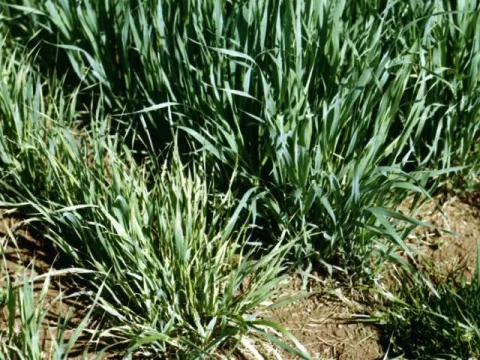
Oat pseudorosette
Oat pseudorosette
The primary symptom of this disease is severe stunting, where plants appear dwarf-like. Internodes of the stems are significantly shortened, causing leaves to cluster densely in the basal zone.
What the section contains
Oat pseudorosette
Leaves of infected plants often exhibit chlorosis, yellowing, or develop an anthocyanin (reddish-purple) tint. Leaf margins may curl, giving the plant a distinctive rosette-like appearance.
When winter barley or oats are infected early in their development, they may fail to reach the shooting stage. Tillering becomes excessive but fails to produce any productive stems.
Heading either does not occur at all, or the panicles and ears remain underdeveloped, deformed, and mostly sterile. Grains in such plants are either non-existent or shriveled and unsuitable for harvesting.
Symptoms often appear in patches within the field, reflecting the localized concentration of insect vectors. The disease spreads in clusters, allowing for visual identification of infected areas across the crop.
The causative agent of oat pseudorosette is a virus transmitted by specific insect vectors. Leafhoppers play a critical role in the pathogen's life cycle as the primary carriers of the virus.
The virus circulates within the insect's body and persists in its salivary glands, ensuring the vector remains infectious for a long duration. Transmission occurs while the insects feed on the vegetative parts of the cereal crop.
Viral particles infect the plant's vascular system, hindering the normal transport of nutrients and growth hormones. This is a systemic disease that affects all plant parts, including the roots, which become degraded.
In addition to oats, the disease affects other cereal crops, including winter barley, wheat, and certain wild grasses. These weeds act as a natural reservoir for the virus between growing seasons.
Intracellular development of the pathogen disrupts chlorophyll synthesis and hormonal balance. This physiological disruption explains the unique leaf discoloration and the plant's inability to develop reproductive structures.
The development and spread of the disease are directly correlated with the population density of leafhoppers. Dry and warm weather promotes active insect reproduction and migration into cereal fields.
Early emergence of winter cereals poses a significant risk, as these crops attract insects during their peak flight period. Early-sown winter barley is particularly susceptible to autumn infection.
High weed infestation creates ideal conditions for the virus to persist. Grassy weeds serve as a "green bridge," facilitating the transmission of the virus from overwintering insects to new crops.
Inadequate pest management on field margins serves as a favorable factor for disease development. The accumulation of leafhoppers on weedy edges is a major source of potential field-wide epidemics.
Higher-than-average temperatures in spring and summer accelerate the insect's life cycle. This reduces the incubation period of the virus within the plant, leading to a faster onset of disease symptoms.
The harmfulness of the disease manifests in substantial yield losses, sometimes leading to total crop failure in specific areas. Infected plants fail to produce marketable grain, severely reducing overall field yields.
Disrupted plant physiology results in low-quality grain, characterized by low thousand-kernel weight and poor filling. Such produce fails to meet the quality standards required for milling and industrial use.
The disease weakens the root system, making plants more vulnerable to abiotic stressors like drought or freezing temperatures. Infected stands exhibit significantly lower overwintering success.
Economic losses include not only direct yield reduction but also the cost of intensive monitoring and additional insecticide applications. Early detection is critical to mitigate large-scale damage.
Intense outbreaks may force farmers to plow under infected sections of the field. This causes direct production losses and disrupts planned crop rotation cycles.
The primary protection strategy involves controlling the vector population through systemic insecticide applications. Treatments must be timed to coincide with the peak activity periods of leafhoppers.
Adhering to optimal sowing dates is an effective agronomic practice. Delaying sowing slightly can reduce the risk of young seedlings coming into contact with vectors during their peak migration.
Rigorous weed control on fields and adjacent areas is essential. Eliminating grassy weeds removes the viral reservoir and reduces the habitat available for leafhopper reproduction.
Utilizing resistant or tolerant oat and barley varieties remains the most effective long-term solution. Breeding for viral resistance is a priority for modern crop improvement programs.
- Maintaining spatial isolation of crops from potential infection sources.
- Treating seeds with insecticidal coatings to protect seedlings during early growth stages.
- Monitoring insect populations using yellow sticky traps to inform timely treatment decisions.