
Swiss needle cast
Nothophaeocryptopus
The disease is caused by the fungus Nothophaeocryptopus gaeumannii. It is a specialized pathogen that affects Douglas-fir (Pseudotsuga menziesii) almost exclusively.
What the section contains
Swiss needle cast
The fungus develops within the needles, specifically colonizing the stomata. It blocks these structures with its mycelium, which interferes with the tree's gas exchange.
Spore production is a continuous process throughout the growing season. The fruiting bodies, known as pseudothecia, emerge from the stomata, giving the needles a characteristic spotted appearance.
The pathogen is capable of surviving on living needles for several years. It does not typically kill the tree outright but causes chronic stress and decline.
Genetic research has refined our understanding of this fungus, but its lifecycle remains a significant concern for both commercial timber production and ornamental planting.
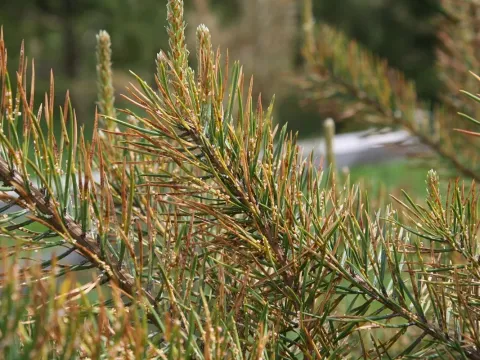
The most prominent symptom is the chlorosis (yellowing) of the needles. Over time, needles fade to a dull yellow or brownish color before dropping prematurely.
Inspection with a magnifying glass reveals rows of tiny black dots on the underside of the needles. These are the fruiting bodies of the fungus emerging from the stomatal rows.
The trees often exhibit thinning crowns. The severity of the needle loss increases from the inner and lower branches outwards and upwards.
Heavily infected trees appear sparse and sickly. In extreme cases, the amount of retained foliage may drop to less than one year's worth of growth.
Symptoms are most easily observed during moist weather when the fruiting bodies are fully developed and visible on the needle surface.
Warm and moist conditions are optimal for the development and spread of the disease. Frequent rainfall and fog provide the necessary moisture for spore germination.
Dense plantations with poor air circulation are highly susceptible to the disease. The humidity trapped within the canopy creates a perfect environment for the fungus.
Spore dispersal is strongly correlated with periods of high humidity and rainfall. During wet springs, the potential for widespread infection increases significantly.
Reduced sunlight in the lower parts of the canopy keeps needles damp for longer periods, which exacerbates the infection process.
Trees under environmental stress, such as those in poor soil or suffering from drought, are generally more susceptible to successful colonization by the fungus.
The primary impact of the disease is the loss of photosynthetic capacity due to premature needle shedding, which directly reduces tree growth rates.
Chronic infection weakens the tree's immune system, making it more vulnerable to secondary attacks by bark beetles and other boring insects.
In forest nurseries, Swiss needle cast can render saplings unsellable, leading to substantial economic losses for growers.
Reduced timber production is a concern in commercial Douglas-fir stands, where growth rates can be stunted by up to 20-50% in severe cases.
Weakened trees are less capable of storing sufficient nutrients for the winter, which can lead to increased winter kill during particularly harsh cold spells.
Managing the disease starts with selecting resistant planting stock. Avoiding the movement of infected seedlings is a critical quarantine measure.
Thinning stands to improve air circulation within the canopy helps to reduce the moisture levels necessary for the fungus to thrive.
Fungicide applications can be used in high-value plantations or ornamental settings. Timing is critical, with treatments usually applied during the spring bud break.
- Monitor trees regularly for the presence of black pseudothecia on the underside of needles.
- Implement site-specific silvicultural practices to manage canopy humidity.
- Use systemic fungicides to control the pathogen if early signs of infestation are detected.
Promoting overall tree vigor through appropriate fertilization and site selection is the best long-term strategy for minimizing the impacts of Swiss needle cast.