
Needle cast
Lophodermium melaleucum
Description
Symptoms
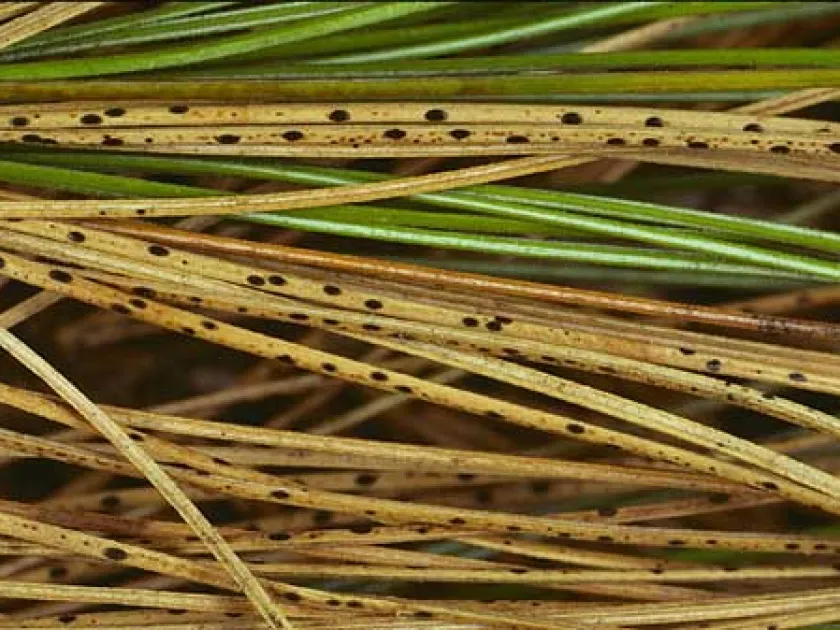
Early symptoms include a yellowing or browning of needles, which typically becomes visible during the spring season following infection.
Characteristic dark brown or black transverse bands often appear across the needles as the fungus colonizes the internal tissues.
Small, elongated black structures, known as apothecia, erupt through the epidermis on the underside of the needles as the disease progresses.
As the infection advances, the needles become brittle, gray, and start to drop prematurely, leading to sparse foliage and visible needle shed.
In cases of high humidity, a fine, whitish mycelial web may be observed on the needles before the final stages of necrosis occur.
Pathogen
The disease is caused by the fungus Lophodermium melaleucum, a member of the Ascomycota phylum, which specializes in parasitic interactions with conifers.
The fungus overwinters within fallen needles as mycelium, waiting for the right conditions to produce its reproductive structures, known as apothecia.
These apothecia release ascospores during rainy periods, which are then dispersed by wind to colonize healthy foliage on neighboring trees.
The pathogen specifically targets the needle tissues, penetrating through stomata to establish a parasitic relationship that eventually kills the host cells.
The biological cycle of this fungus is highly dependent on environmental cycles, meaning its prevalence varies significantly from year to year based on weather.
Conditions for development
High humidity and moderate temperatures are the most critical factors driving the development and spread of this fungal disease.
Dense, overcrowded planting patterns limit air movement, allowing needles to remain wet for extended periods, which is essential for spore germination.
Prolonged rainy seasons, especially during the summer and early autumn, significantly increase the risk of an outbreak in both forests and nurseries.
Trees that are already stressed due to poor soil quality, drought, or nutrient deficiencies are significantly more susceptible to successful colonization.
The presence of deep needle litter provides an ideal environment for the fungus to survive throughout the winter, ensuring a steady source of inoculum.
Why it matters
The primary impact of needle cast is the massive premature loss of needles, which severely compromises the tree's ability to photosynthesize.
Significant growth retardation is a common consequence of chronic infection, as the tree diverts energy from growth to immune response and repair.
In forest nurseries, this disease can lead to the total loss of seedlings, making it a major economic concern for forest management and reforestation programs.
Weakened trees become far more susceptible to secondary infestations, particularly by bark beetles and other borers that target stressed coniferous wood.
The aesthetic value of trees in landscaping is severely degraded, as the crown becomes thin, sparse, and exhibits characteristic patches of dead foliage.
Protection
Sanitation is the most effective cultural practice, which involves the removal and destruction of fallen needles to eliminate the source of infection.
Regular monitoring of young plantations during humid weather is essential to detect the onset of disease early and apply necessary treatments.
Fungicide applications, particularly those containing copper or systemic active ingredients, are effective if timed correctly before the major spore-dispersal phase.
Improving air circulation through proper spacing and thinning of dense stands reduces the moisture levels necessary for fungal colonization.
- Selection of resistant tree species for planting in high-risk areas.
- Application of balanced fertilizers to support vigorous tree growth.
- Pruning and destruction of heavily infected branches to reduce spore load.
Discussion
No discussions yet — be the first.