
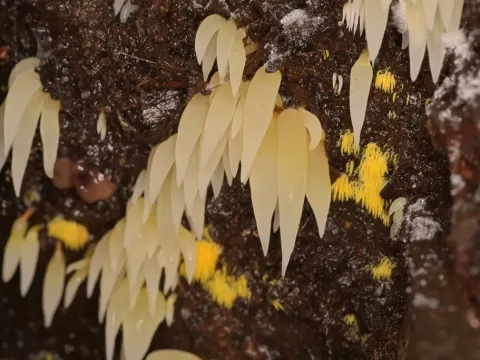
Mucronella calva
Mucronella calva
The pathogen is a basidiomycetous fungus known as Mucronella calva, belonging to the Clavariaceae family. It is a distinct woodland fungus that typically acts as a saprotroph, colonizing dead or stressed wood material.
What the section contains
Mucronella calva
This fungus forms unique, small, spine-like fruiting bodies that hang downwards. These spines do not share a common base and are scattered across the surface of the wood, which is a key identifying feature of the species.
The biology of Mucronella calva is deeply linked to the degradation of lignin and cellulose in wooden structures. The pathogen utilizes specialized enzymes to break down cell walls, allowing the mycelium to extract nutrients from the wood tissue.
Unlike many other wood-decay fungi, it does not produce large caps or massive brackets. Its reproduction strategy relies on the dispersal of basidiospores that are easily carried by air currents over significant distances.
The growth of this fungus is strictly dependent on stable moisture levels. Consequently, it is most frequently found in damp, shaded environments where wood remains saturated for extended periods.
Visual signs of infection include the appearance of numerous white or pale-cream spine-shaped structures on the bark or wood surface. They appear as small, scattered needles pointing vertically toward the ground.
Wood colonized by this fungus gradually lightens in color, indicating the development of white rot. Over time, the wood loses its structural integrity and becomes brittle under even minor mechanical pressure.
The texture of the wood becomes fibrous and crumbles easily upon touch. This is a direct consequence of the fungus breaking down the structural framework of the tree, rendering it unsuitable for timber use.
Clustering of the fungal spines on the surface of tree trunks often resembles bristles covering large areas. This pattern is particularly visible on the underside of fallen trees lying in the forest undergrowth.
It is important to remember that the spore-bearing surface is located directly on these spines. The complete absence of gills or pores is the definitive characteristic that separates this species from other wood-inhabiting pathogens.
High humidity is the primary driver for the development of Mucronella calva. The fungus thrives in environments where humidity levels consistently exceed 70%, which is typical in dense, unmanaged forest stands.
Moderate temperatures favor the fungus. It exhibits optimal growth within a range of +15 to +22 degrees Celsius, corresponding to the climatic conditions of most temperate forest zones during the growing season.
Mechanical damage to the bark or wounds sustained during forest management serve as entry points for spores. Damaged wood provides an ideal substrate for the rapid colonization of fungal mycelium.
Poorly ventilated forest areas with large accumulations of decaying debris create a unique microclimate that promotes the long-term survival and reproduction of this pathogen.
Persistent rainfall and waterlogged soil indirectly increase the risk of infection by saturating the lower tiers of trees, making them more conducive to colonization by the fungus.
The main impact of Mucronella calva is the reduction of the technical quality of wood. Infested trunks lose their strength, making them unsafe and unsuitable for use in construction or industrial processing.
In forest ecosystems, the fungus accelerates the degradation of weakened trees. While this is part of natural nutrient cycling, in commercial forests, such losses result in reduced productivity and significant economic damage.
Infection of living trees leads to a gradual decline in their vigor. This manifests as premature needle or leaf drop, the drying of individual branches, and overall growth suppression.
The risk of windthrow increases significantly as the fungus actively destroys not just the trunk, but also the structural integrity of the root system, weakening the tree's anchorage in the soil.
Mitigation efforts require substantial financial and time resources, including sanitary thinning and the systematic removal of infested wood from the forest floor to prevent further spore spread.
The primary control method is sanitary maintenance. Identifying and removing infested trees promptly helps reduce the concentration of spores in the air and limits the spread of the fungus.
Managing the density of forest stands helps improve aeration. Dry air has a detrimental effect on the mycelium of Mucronella calva; therefore, maintaining optimal light and airflow is key to forest health.
In parklands and gardens, it is recommended to disinfect tree wounds occurring from damage using specialized wound sealants or copper-based fungicide solutions to prevent fungal entry.
Accumulation of decaying debris and deadwood should be avoided as they act as reservoirs for the infection. Proper disposal of such material significantly reduces the risk of new disease outbreaks.
- Systematic monitoring of forest stand health.
- Prompt removal of deadwood and fallen trees.
- Protection of bark from physical damage during logging.
- Optimization of light and airflow in forest plots.
- Use of fungicides for treating wounds on valuable trees.