
Mulberry leaf spot
Marssonina necans
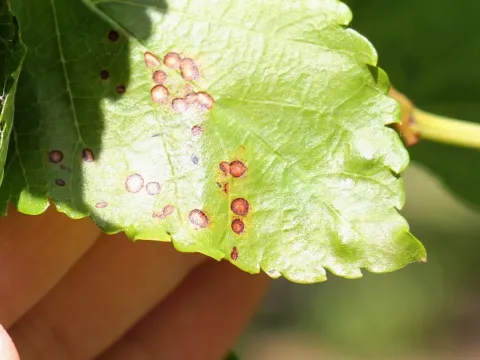
The main symptom of the disease is the appearance of distinct spots on the mulberry leaves. Initially, these spots are small, round or angular, and brown in color.
What the section contains
Mulberry leaf spot
Over time, the spots expand and can merge, covering significant portions of the leaf surface. Affected tissues often become necrotic, dry out, and may crack.
On the underside of the leaves, fungal spore-bearing structures appear within the spotted areas. These look like small white or creamy cushions or dots.
Heavy infection causes premature yellowing and mass defoliation by mid-summer, which significantly weakens the tree before the winter dormant period.
In severe cases, the disease affects young shoots and buds, resulting in dieback and reducing the overall vigor and productivity of the tree.
The disease is caused by the pathogenic fungus Marssonina necans. It is a specialist pathogen that primarily targets the leaves and annual shoots of mulberry trees.
This fungus belongs to the imperfect fungi group and spreads via conidia dispersed by wind, rain splashes, and insects.
The pathogen overwinters in fallen infected leaves and on the bark of affected shoots in the form of mycelium or spores.
In the spring, once environmental conditions become favorable, the pathogen begins active sporulation, causing primary infections on healthy plant tissues.
The fungal life cycle is closely linked to periods of high humidity and moisture, which are essential for spore germination and colonization of the host plant.
Development of the disease is favored by warm and rainy weather during the spring and summer months. High humidity and water films on leaves create ideal conditions for infection.
Poor aeration within the canopy due to dense planting significantly accelerates the spread of the pathogen between branches and neighboring trees.
Failure to remove fallen leaves creates a persistent source of inoculum that can survive from one season to the next.
Stressed trees, particularly those with nutrient deficiencies or those weakened by insect attacks, are more susceptible to Marssonina infections.
The peak of disease incidence usually occurs in the second half of summer when humidity levels are consistently high, coinciding with a potential decline in tree immunity.
The primary damage is the disruption of photosynthesis due to the loss of leaf surface area, leading to the depletion of the tree's energy reserves.
Premature leaf drop prevents proper shoot maturation, making the tree highly vulnerable to freezing temperatures and frost injury during winter.
Fruit yield reduction is a direct result of impaired metabolic processes and reduced nutrient supply to the developing berries.
Chronic infection over several growing seasons leads to gradual tree decline, branch dieback, and stunted growth.
Agricultural operations face financial losses not only from yield reduction but also from the costs associated with disease management and potential tree replacement.
The most important control measure is the thorough collection and destruction of all fallen leaves in autumn to eliminate the primary overwintering source of infection.
Regular sanitary pruning is necessary to remove infected shoots and improve air circulation within the canopy, which lowers local humidity.
For prevention, dormant-season spraying with copper-based fungicides is recommended before the buds start to swell in the spring.
During the growing season, if initial spots are observed, application of systemic fungicides should be carried out according to local agricultural guidelines.
- Maintain appropriate planting density for good ventilation
- Apply balanced fertilizers to boost overall tree immunity
- Monitor and control insects that damage leaf tissues