
Poplar and squill rust
Melampsora rostrupii
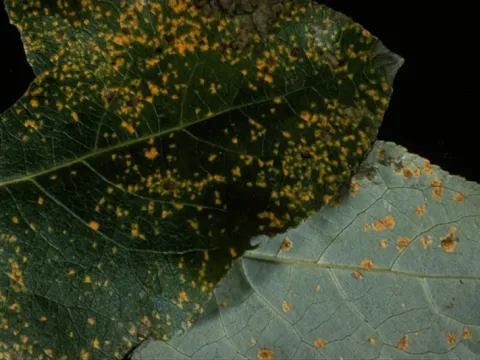
The first signs of infection on poplar leaves appear as bright orange or yellow pustules, which are the spore-producing structures of the fungus known as uredinia.
What the section contains
Poplar and squill rust
As the disease progresses, brown spots develop around these pustules, leading to tissue necrosis. Leaves may yellow prematurely, curl, and drop well before the autumn season.
On the alternate host, the squill (Scilla), early spring symptoms appear on the undersides of leaves and stems as orange-yellow aecia, marking the start of the infection cycle.
Massive infections give the tree a scorched appearance, which is particularly detrimental in urban and park landscapes where aesthetics are crucial.
Defoliation is the most common consequence of severe infection, which can be seen in trees that lose their canopy prematurely in late summer.
The causal agent is Melampsora rostrupii, a heteroecious rust fungus belonging to the Basidiomycota division, requiring two different hosts to complete its life cycle.
The aecial stage occurs on Scilla species, where the fungus overwinters and produces spores that infect poplar trees during the spring months.
On poplars, the fungus goes through uredinial and telial stages. Urediniospores allow the disease to spread rapidly between poplar trees throughout the growing season.
By autumn, teliospores form on the fallen leaves, which serve as the overwintering structure for the fungus, allowing it to survive through cold periods.
Because the fungus utilizes two hosts, it is highly resilient and difficult to eradicate if both host plants are present in the same ecosystem.
The development of Melampsora rostrupii is favored by mild temperatures (15-22°C) combined with high humidity, rainfall, or persistent morning dews.
Dense plantations with poor airflow create a stagnant microclimate that promotes the germination of fungal spores on leaf surfaces.
The proximity of poplar stands to natural populations of squill (Scilla) significantly increases the infection pressure during the early spring.
Drought-stressed or nutritionally deficient trees are more susceptible to the infection, as their natural defense mechanisms are weakened.
Conversely, dry and hot spring conditions can significantly suppress the initial infection wave, as fungal spores require moisture to germinate.
The primary impact of the disease is premature defoliation, which reduces the tree's ability to photosynthesize and accumulate starch for winter survival.
Persistent yearly infections lead to stunted growth, loss of vigor, and reduced annual wood increment, which is a major concern in commercial plantations.
In ornamental poplars, the aesthetic damage caused by leaf yellowing and necrosis forces arborists to intervene with chemical controls.
Young trees are especially vulnerable to crown malformations and stem twisting, which can lead to structural issues as the tree matures.
Severely weakened trees often become secondary hosts for wood-boring insects and other pests that can eventually kill the tree.
The most effective management strategy is the thorough collection and destruction of all fallen leaves during autumn to remove the overwintering teliospores.
Land management should focus on spatial separation between poplar plantings and areas where squill naturally occurs to break the life cycle.
Fungicide applications, particularly those containing copper or systemic triazoles, are effective if applied preventively during early symptom development.
Maintaining tree vigor through proper fertilization, irrigation, and avoiding overcrowded planting patterns helps trees resist infection.
- Selecting resistant poplar clones for new plantings.
- Pruning for improved air circulation within the canopy.
- Regular monitoring of host plants in early spring.