
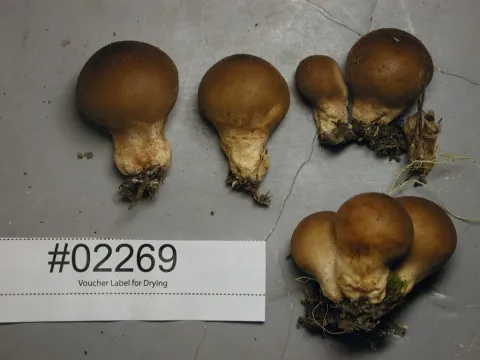
Handkea lycoperdoides
Handkea lycoperdoides
Handkea lycoperdoides is a saprotrophic fungus belonging to the Agaricaceae family. It is widely recognized in mycological studies for its role in soil decomposition.
What the section contains
Handkea lycoperdoides
The fungus is not a plant pathogen; it does not infect living crops or cause diseases in agricultural plants, serving instead as a natural decomposer.
Its biological structure consists of a mycelium network that colonizes organic-rich substrates, such as leaf litter and decaying plant matter.
The fruiting body is typically pear-shaped, which produces mature spores that are released into the environment to initiate new colonies.
As a saprotroph, it is an essential component of the soil food web, assisting in the breakdown of complex organic molecules.
The growth of Handkea lycoperdoides is heavily influenced by environmental moisture levels and the availability of nutrient-rich organic debris.
Mild temperatures ranging from 15°C to 25°C provide optimal conditions for the rapid development of its characteristic fruiting bodies.
Well-aerated soils with a neutral to slightly acidic pH offer the most suitable environment for the fungal mycelium to thrive.
High humidity and rainfall are critical factors that trigger the sporulation phase, allowing the fungus to spread across field edges.
It is commonly found in pastures, meadows, and areas where previous crop residues have not been fully incorporated into the soil.
There is no agricultural harm associated with Handkea lycoperdoides, as it lacks the physiological ability to parasitize living plant tissues.
The presence of this fungus is often a bio-indicator of rich, organic soil rather than a sign of pathological infestation or crop failure.
While it does not damage crops, its mass appearance may suggest an accumulation of excessive surface organic matter that requires management.
Unlike parasitic fungi, this species does not compete for water or mineral nutrients directly with the root systems of agricultural crops.
It poses no risk to yield quality and does not produce toxins that could inhibit the development of neighboring agricultural vegetation.
No chemical pesticides or fungicides are required for Handkea lycoperdoides, as it is a beneficial part of the natural soil ecology.
If its growth is undesirable, standard agricultural practices such as deep tillage and soil aeration are sufficient to control the substrate it relies on.
Maintaining a clean field environment by properly incorporating crop residues reduces the surface food supply for this saprotrophic fungus.
Balanced soil fertilization programs help prevent the buildup of superficial organic waste, effectively discouraging fungal development.
Standard irrigation management, preventing long-term waterlogging, remains the best practice for maintaining overall soil health and managing fungal presence.