
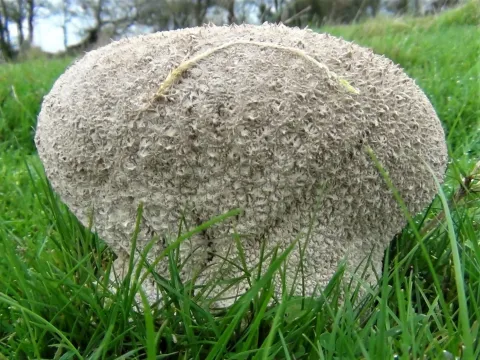
Handkea utriformis
Handkea utriformis
Handkea utriformis, commonly known as the mosaic puffball, is a saprotrophic fungus belonging to the Agaricaceae family. It is strictly a soil-dwelling organism that breaks down dead organic matter.
What the section contains
Handkea utriformis
The fungus is not a plant pathogen. It does not possess the biological equipment, such as haustoria, to infect or harm living plant tissues or disrupt their physiological processes.
Its primary role in the field ecosystem is the decomposition of cellulose and lignin. By breaking down plant debris, it contributes to nutrient cycling and the formation of soil humus.
Because it is a decomposer and not a parasite, Handkea utriformis has no impact on crop yield, plant health, or economic productivity in agricultural settings.
Agronomists should view this fungus as a natural component of a healthy soil ecosystem rather than a biological threat to be controlled.
The fruiting body is distinctively shaped, often resembling an inverted iron or a pear with folds. When young, it is light-colored, ranging from white to greyish-white.
As the fungus matures, the upper membrane splits to form a cup-like shape. This structure facilitates the dispersal of spores by wind or rain drops hitting the surface.
The interior (gleba) starts as a firm white mass and transitions into a brown, powdery spore mass as the fungus ages, which is a normal life cycle stage.
Unlike parasitic fungi that cause leaf spots or wilting, Handkea utriformis does not appear on the foliage or stems of cultivated plants.
The mushroom is typically found growing on the soil surface in meadows, pastures, or field edges where there is sufficient organic matter present.
This species thrives in moist conditions, particularly during the transition from summer to autumn. High levels of humidity and rain often trigger the emergence of fruiting bodies.
It prefers well-drained but fertile soils with plenty of decaying plant material. The fungus is most active in neutral to slightly alkaline soil environments.
While moisture is essential, the fungus is sensitive to prolonged waterlogging. It generally requires moderate temperatures to sustain mycelial growth in the topsoil layer.
Intensive soil cultivation, such as plowing, significantly reduces the presence of this fungus by disrupting its vegetative mycelium network.
The abundance of the fungus is often correlated with the presence of straw or organic residues left on the soil surface, providing a substrate for colonization.
Handkea utriformis is entirely harmless to crops. It does not secrete toxins, cause rot, or compete for space in a way that would disadvantage crop production.
There is no economic damage associated with this fungus. Its presence is purely a biological indicator of active decomposition occurring within the soil matrix.
Misidentifying this fungus as a crop disease can lead to unnecessary costs and chemical interventions that are detrimental to soil microbial diversity.
The dispersal of spores is a mechanical process and does not result in the infection of crop leaves, as the spores require organic soil substrate to germinate.
For sustainable agriculture, the presence of such saprotrophs should be encouraged as they help maintain long-term soil structure and fertility.
No chemical or biological control methods are necessary as Handkea utriformis is not a pest or a disease agent. Fungicidal applications are discouraged due to their non-target impact.
If management is required for aesthetic purposes or ground maintenance, mechanical removal of the fruiting bodies before they release their spores is sufficient.
Improving soil drainage and standard field aeration techniques are effective ways to reduce the environmental favorability for large puffball growth.
Integrated soil management, including the consistent incorporation of crop residues, helps manage the accumulation of substrates that the fungus utilizes.
- Mechanical tillage.
- Soil drainage management.
- Crop residue incorporation.