
Fusarium wilt of avocado
Graphium euwallaceae
The causative agent of this disease is the fungus Graphium euwallaceae, which exists in a symbiotic relationship with ambrosia beetles of the genus Euwallacea. The pathogen invades the tree through the tunnels bored by these insects.
What the section contains
Fusarium wilt of avocado
This disease is categorized as a vascular wilt. The fungus proliferates within the tree's xylem, causing blockages that disrupt the transport of water and nutrients to the canopy.
The fungus is highly virulent and capable of colonizing both young and mature avocado trees. Once it establishes itself, it spreads systemically throughout the vascular system.
The beetle acts as a vector, carrying the fungal spores in specialized structures called mycangia. This ensures that the pathogen is delivered directly into the heartwood of the tree.
Biological studies indicate that the interaction between the beetle and the fungus is a complex mechanism, making this pathogen difficult to manage once it takes hold in an orchard.
The primary symptom is sudden leaf wilting, where leaves remain attached but quickly lose their green color and vitality. This reflects the failure of the hydraulic system.
Small entry holes on the bark, created by the beetles, are telltale signs of infestation. These spots often show evidence of sap exudation or "weeping" from the tree.
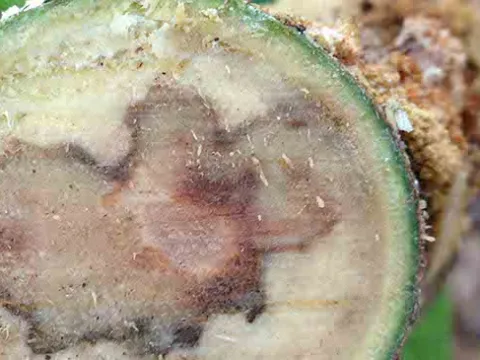
Upon removing the bark, you will observe dark, necrotic streaks or stains in the wood. These are the result of the tree's internal defense response and the fungal spread.
Dieback is a common feature, where individual branches wither and die, eventually leading to a sparse canopy and the total collapse of the tree's structure.
In advanced stages, the entire tree may die within a single growing season. The speed of decline is a hallmark of this aggressive vascular disease.
The disease development is entirely dependent on the presence and activity of the Euwallacea beetle. Without the vector, the fungus lacks an efficient way to penetrate the bark.
Trees that are under stress, whether from drought, nutrient deficiency, or poor soil health, are significantly more attractive to the beetles, which enhances susceptibility.
Warm temperatures and favorable humidity levels increase beetle activity, facilitating the colonization of healthy trees by the fungus during their swarming season.
Mechanical transmission is also possible through poorly sanitized pruning equipment. If an infected tree is pruned, the tools can easily introduce the fungus to neighboring trees.
The establishment of the pathogen is often tied to the movement of infested wood, firewood, or nursery stock, which provides the beetles and fungus easy access to new areas.
Fusarium wilt represents a devastating threat to avocado production worldwide, capable of killing large numbers of trees and threatening the economic viability of orchards.
The difficulty in early detection is a major harm. Often, by the time the wilting symptoms are visible to the grower, the fungus has already caused irreversible damage.
The financial impact is profound, resulting from the cost of removing infected trees, the loss of fruit production, and the necessary expenditures for stringent quarantine protocols.
Infected trees act as reservoirs, sustaining the beetle population and the fungal inoculum, which puts all surrounding avocado trees at an immediate high risk.
The presence of this complex in a region often leads to strict regulations, limiting the ability of farmers to trade or sell nursery materials outside the infested zone.
Early detection and monitoring are the most effective management practices. Orchardists should regularly scout for entry holes, sap spots, and branch dieback symptoms.
If an infestation is confirmed, affected trees must be promptly removed, chipped, and disposed of (preferably burned) to eliminate the source of the vector and the pathogen.
- Deploy pheromone traps to monitor and reduce the local population of ambrosia beetles.
- Strictly sanitize all pruning tools between trees to prevent cross-contamination.
- Maintain optimal tree health through irrigation and fertilization to minimize stress.
- Implement strict quarantine measures for the movement of wood products and nursery trees.
Current chemical control methods primarily target the beetle vector with insecticides, as systemic fungicides are largely ineffective against the fungus inside the woody tissues.
Ongoing research is focused on developing resistant rootstocks and biological control agents to mitigate the impact of this aggressive beetle-fungus complex.