
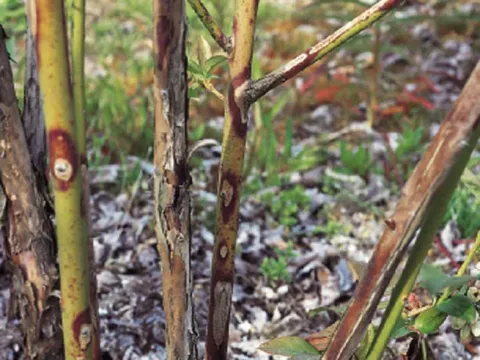
Godronia Canker
Godronia urceolus
Godronia canker is a significant fungal disease caused by the pathogen Godronia urceolus (anamorph Fusicoccum putrefaciens). It primarily targets woody perennials, with berry bushes being particularly susceptible to its damaging effects.
What the section contains
Godronia Canker
The pathogen survives within infected tissues throughout the winter, manifesting as mycelium or small fruiting bodies known as apothecia. With the return of warmer, humid weather in spring, these structures release spores that spread the infection.
Infection usually begins when spores land on wounds, cracks, or pruning sites on the stems. Once inside, the fungus colonizes the bark and woody tissue, gradually expanding its necrotic reach.
The lifecycle of this fungus is heavily dependent on moisture and moderate temperatures. Under favorable conditions, the infection spreads systematically throughout the vascular system of the branches.
By producing potent enzymes, the fungus breaks down the plant’s cellular structure, leading to the formation of characteristic cankers that interrupt nutrient flow and weaken the host plant.
The primary symptom of Godronia canker is the appearance of depressed, discolored spots on stems. Over time, these areas enlarge and deepen, forming distinct brownish-red or dark-colored cankers.
As the disease progresses, the bark on the affected areas begins to crack, peel, and eventually disintegrate. This leads to the girdling of the stems, which is lethal to the portion of the plant above the lesion.
During wet weather, small, dark, pimple-like fruiting bodies appear on the surface of the canker. These represent the active sporulation phase, allowing the fungus to spread further across the field.
Leaves on infected branches often display symptoms such as chlorosis, yellowing, or early wilting. The overall vigor of the plant declines, and growth becomes stunted.
If left untreated, the cankers can completely encircle the stem, causing the entire branch to die back suddenly. In severe cases, the entire bush may perish.
High humidity and consistent rainfall are the most critical factors for the development of Godronia canker. Spore dispersal is most efficient when moisture is abundant on the plant surfaces.
Poor air circulation, often caused by overly dense planting or improper pruning, creates an ideal microclimate for the pathogen. Stagnant air keeps foliage wet for longer periods, promoting fungal growth.
Mechanical injuries resulting from garden maintenance, insect damage, or frost cracks provide easy entry points for the fungal spores to colonize the woody tissues of the plant.
Excessive nitrogen fertilizer promotes rapid, succulent growth that is less hardy and more susceptible to infection. Such plants are significantly more likely to develop severe canker infestations.
Neglecting orchard hygiene—such as leaving infected prunings on the ground—allows the pathogen to survive and re-infect the planting during the next growing season.
Godronia canker causes substantial economic losses by reducing fruit yield and plant longevity. Damaged branches are unable to support healthy fruit production, leading to lower quality crops.
The rapid spread of the disease can force producers to remove entire bushes, representing a complete loss of investment and future productivity for those specific plants.
Infected plants exhibit reduced winter hardiness, making them more susceptible to cold damage. This often leads to a cycle of decline that is difficult to reverse without aggressive intervention.
Because the disease can spread via infected nursery stock, it poses a long-term risk for new plantations. Early detection is often difficult, allowing the infection to become well-established.
The cumulative impact of the disease results in degraded plant health, increased management costs for fungicides, and the labor-intensive need for repeated pruning cycles.
Effective management begins with rigorous sanitation. All infected stems should be pruned well below the site of the canker and immediately destroyed by burning to eliminate the inoculum source.
Proper plant spacing and regular pruning are essential to improve light penetration and air movement, which keeps the foliage and stems dry and less hospitable to the fungus.
Fungicide applications, particularly those containing copper or systemic active ingredients, can provide a protective barrier. Timing these sprays during the early spring and autumn is crucial.
- Prune out and remove all dead or symptomatic branches annually.
- Disinfect all pruning tools between cuts to prevent cross-contamination.
- Maintain balanced fertilization to ensure optimal plant hardiness and wood maturation.
Applying protective sealants to larger pruning cuts can help prevent the entry of spores. Additionally, sourcing certified disease-free nursery stock is the most important step for long-term control.