
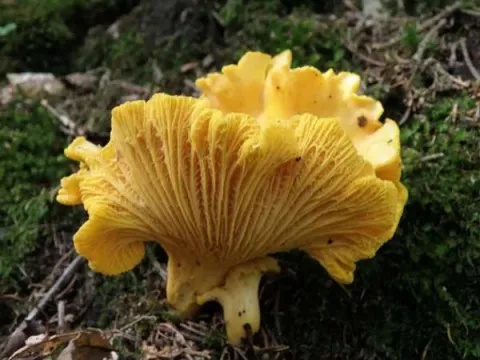
Golden chanterelle
Cantharellus cibarius
The golden chanterelle (Cantharellus cibarius) is not a plant disease. It is a well-known mycorrhizal fungus that lives in a mutualistic symbiosis with the roots of trees.
What the section contains
Golden chanterelle
This fungus acts as an ectomycorrhizal partner, facilitating nutrient exchange rather than attacking the plant as a parasite or pathogen.
The organism does not cause any necrosis, chlorosis, or vascular system damage typically associated with crop diseases.
Biological interactions between the chanterelle mycelium and host roots are beneficial, improving the tree's access to water and essential minerals.
Therefore, classifying this species as a disease agent is biologically incorrect and misleading for any agronomic assessment.
Growth requirements for the mycelium involve proximity to healthy deciduous or coniferous trees, such as spruce, pine, or oak.
Acidic, humus-rich soil profiles are essential for the survival of the fungus and its continued symbiotic relationship with forest trees.
High relative humidity and moderate temperatures are critical for the formation of fruiting bodies during the late summer and autumn seasons.
The fungus is highly sensitive to changes in soil chemistry, particularly regarding nitrate accumulation, which can hinder the symbiotic connection.
Spore germination depends on the availability of suitable root exudates from host trees, ensuring that the mycelium reaches its host quickly.
There is no evidence of harm caused by the golden chanterelle to forest health or agricultural crop development.
On the contrary, the presence of these fungi is often considered a bioindicator of high soil quality and a healthy symbiotic forest environment.
No protective or control measures are required, as the species is a natural component of a balanced ecosystem rather than a pest or disease.
The fungus does not consume living plant tissue, meaning it poses no risk to plant physiological processes or structural integrity.
Agronomists classify this species as a beneficial symbiont, and its conservation is often encouraged to support long-term ecosystem stability.