
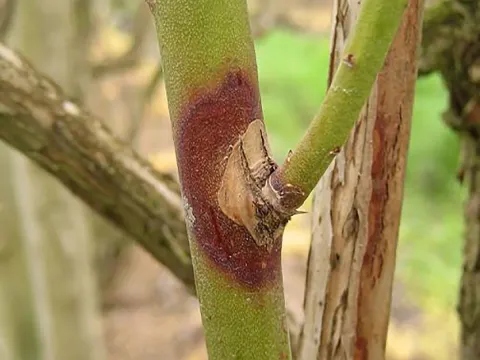
Godronia ribis
Godronia ribis
The disease is caused by the ascomycete fungus Godronia ribis (also known as Fuckelia ribis). It is a significant pathogen that targets the stems and bark of currant bushes.
What the section contains
Godronia ribis
The fungus functions as a parasite, infecting the host plant and disrupting its vascular system, which leads to the eventual death of branches and stems.
The pathogen survives the winter in the mycelium form within the bark of infected branches, persisting in dead or weakened plant tissues.
In spring, when environmental conditions become suitable, the fungus produces spores. These spores are disseminated via wind, splashing rain, and insect vectors.
Once the spores land on a suitable host, they germinate and penetrate the stem, often utilizing small wounds or natural cracks to enter the plant's vascular tissue.
The primary symptom is the development of elongated, necrotic lesions on the branches. These spots usually appear brown or reddish-brown in color.
As the infection deepens, these areas become sunken and cracked, exposing the underlying woody tissue, which gives the branches a withered appearance.
Fruiting bodies of the fungus, called apothecia, can be observed on the surface of the lesions as small, waxy, yellow-brown or reddish structures.
Leaves on infected branches often display signs of distress, turning yellow or wilting prematurely because the water transport is severely restricted.
In severe cases, the necrosis encircles the branch, causing complete dieback of the portion of the branch located above the infection site.
Godronia ribis thrives in high-humidity environments, especially during periods of prolonged rainfall or when morning dew persists on the foliage.
Densely planted orchards with poor air circulation create a microclimate that allows the fungus to spread rapidly from one branch to another.
Physical injuries to the bark, such as those caused by frost, pruning shears, or pests, provide immediate entry points for fungal spores to colonize the plant.
Neglecting to remove old, dead, or diseased wood provides a reservoir for the fungus to reproduce year after year, increasing the infection pressure.
Insufficient sunlight exposure, often caused by the lack of proper pruning, keeps the center of the bushes damp, encouraging the growth of the pathogen.
The economic impact of the disease includes a decrease in berry production and the gradual loss of productive branches on the currant bushes.
If left unmanaged, the infection can systematically kill entire bushes over several years, necessitating their removal and replacement with new plants.
The health of the entire plant is compromised, making it less vigorous and more susceptible to other biotic and abiotic stress factors, such as winter cold.
The presence of the fungus reduces the overall quality of the fruit, as the plant cannot provide adequate nutrients to the developing clusters.
An infected bush acts as a constant threat to neighboring healthy plants, potentially leading to an outbreak across the entire berry plantation.
Strict sanitation practices, including the regular removal and immediate destruction of all infected branches, are essential to stop the spread of the fungus.
Pruning should be performed in dry weather, and tools must be disinfected after each cut to avoid cross-contaminating healthy wood.
Applying copper-based fungicides as a preventative measure in early spring, before bud break, can significantly reduce spore germination rates.
Maintaining optimal spacing between plants and keeping the base of the bushes free from debris improves air circulation and lowers humidity levels.
Selecting resistant cultivars and ensuring balanced plant nutrition strengthens the plant's natural defense mechanisms against this and other fungal infections.