
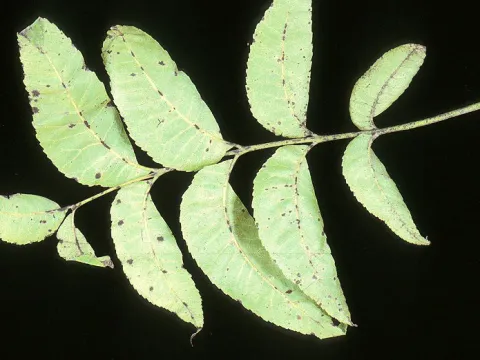
Gnomonia leaf spot of walnut
Gnomonia nerviseda
The causative agent of this disease is the highly specialized ascomycete fungus Gnomonia nerviseda. This pathogen specifically targets the leaf tissue, frequently colonizing the area around the veins, which is reflected in its scientific name.
What the section contains
Gnomonia leaf spot of walnut
The fungus completes its life cycle by forming fruiting bodies on fallen leaves, where it successfully overwinters. In the spring, when conditions become favorable, ascospores are released and spread by wind or rain splashes to young walnut leaves.
This disease is categorized as a leaf spot. The fungus penetrates through the stomata or micro-injuries in the epidermis, actively developing mycelium within the leaf tissues, which triggers necrotic processes.
Infection can occur throughout the growing season if moisture levels remain high. Subsequent cycles of sporulation during the summer months facilitate the rapid spread of the infection throughout the tree canopy.
The biology of the pathogen is closely tied to the presence of plant debris, which acts as the primary source of initial infection in the spring, making sanitary orchard management a critical necessity.
Initial symptoms of the disease appear as small, distinct brown or dark-colored spots. These lesions most frequently localize along the central vein of the leaf, gradually expanding over time.
As the disease progresses, these spots coalesce, covering significant portions of the leaf blade. The affected tissues begin to deform and curl, giving the tree a sickly, depressed appearance.
On the underside of the leaf, one can observe small dark dots within the necrotic areas; these are the fungal fruiting bodies (pycnidia or perithecia). Under high humidity, these structures produce spore masses.
In severe cases, the infection spreads to leaf stalks and young green shoots. This results in premature defoliation, which occurs significantly earlier than the natural biological senescence of the leaves.
Visually, the disease can be mistaken for anthracnose, but with Gnomonia infection, the necrotic lesions are more strictly associated with the vascular system of the leaf and often exhibit an elongated, angular shape.
The development of the disease is favored by high air humidity, frequent fog, and prolonged rainfall during the spring and summer. Water droplets serve as the primary vector for transporting spores from fallen leaves to the canopy.
The optimal temperature range for spore germination and active fungal mycelium growth is between 18 and 25 degrees Celsius. Warm and wet weather conditions typically trigger severe outbreaks.
Dense walnut plantings, where air circulation is restricted and moisture remains on the foliage for extended periods, represent high-risk zones. Poor canopy aeration creates an ideal microclimate for the fungus.
Neglecting autumn pruning and failing to remove fallen leaves leads to the accumulation of a massive infectious load under the tree, guaranteeing reinfection in the following growing season.
A reduction in the tree's overall immunity due to mineral nutrient deficiencies or damage from pests also makes the plant more susceptible to successful fungal penetration.
Gnomonia causes serious damage to the tree's photosynthetic apparatus. Premature leaf fall prevents the plant from storing sufficient nutrients in preparation for the winter dormancy period.
Reduced photosynthetic efficiency leads to incomplete fruit maturation. The walnuts become smaller, lose their market value, and the kernels are frequently underdeveloped or shriveled.
Repeated severe infection over several consecutive seasons weakens the tree, reduces its cold hardiness, and stunts shoot growth. Eventually, this can lead to the death of individual branches.
For commercial orchards, this disease poses a threat through significant economic losses. The quality of the harvest declines, and the costs associated with disease management and restorative measures increase substantially.
Trees weakened by this disease become more susceptible to secondary fungal infections and pest infestations, which triggers a broader mechanism of orchard degradation.
The foundation of control is an agrotechnical approach: mandatory collection and burning or deep burial of fallen leaves in the autumn. This removes the main source of infection from the orchard environment.
It is essential to conduct regular sanitary and thinning pruning of the canopy. This improves aeration and light penetration into the foliage, significantly reducing the humidity levels inside the crown.
- Application of copper-based fungicides (Bordeaux mixture) during the vegetative period.
- Preventive spray applications in early spring before bud break.
- Balanced application of potassium-phosphorus fertilizers to strengthen leaf tissues.
- Timely pest control to prevent damage that facilitates fungal entry.
Chemical protection involves the use of systemic fungicides during periods of active shoot growth. Treatments should commence at the first signs of the disease, following the specific regulations for each pesticide.
Adhering to proper planting guidelines — maintaining sufficient distance between trees — allows for delaying the start of epiphytotics by creating conditions unfavorable for the mass reproduction of the pathogen.