
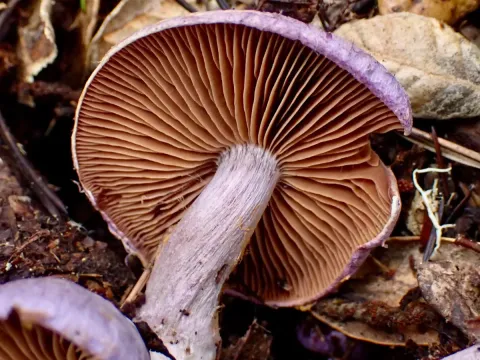
Goat webcap
Cortinarius traganus
The goat webcap (Cortinarius traganus) is a member of the Cortinariaceae family. It is not a plant pathogen, but rather a beneficial mycorrhizal fungus that plays a vital role in forest ecosystems.
What the section contains
Goat webcap
Instead of attacking plants, the fungus establishes a mutualistic relationship with the root systems of various tree species, particularly conifers and birch. This connection helps trees absorb minerals more effectively.
The fungus functions by extending its mycelium through the soil and forest floor. It acts as a recycler of organic material, contributing to the health of the woodland environment.
It does not cause diseases in agricultural crops. Its presence is generally a sign of a healthy, undisturbed forest soil ecosystem rather than a threat to vegetation.
The life cycle involves the production of fruit bodies known as mushrooms, which emerge during the late summer and autumn seasons to release spores into the wind.
The most distinctive sign of the goat webcap is its bright violet color in the young stages. As the mushroom ages, the cap shifts towards a dull brownish or ochre hue.
The mushroom is widely recognized by its unpleasant, pungent odor, often compared to acetylene or goats. This scent is persistent and is a key feature for identification.
The flesh of the mushroom typically yellows or turns saffron-colored when bruised or cut. This color change is a reliable field characteristic for mycologists.
The gills of young specimens are deeply violet, eventually turning a rusty-brown color as the spores mature and deposit on the gills.
The stalk is thick and often club-shaped, featuring distinct web-like remnants of the partial veil, known as the cortina. These remnants may trap spores, giving them a rusty appearance.
Goat webcaps prefer acidic soil environments found in coniferous or mixed forests. They are strictly associated with the roots of specific tree partners for their survival.
High levels of humidity are essential for the production of fruit bodies. Rainy periods in late summer usually trigger the mass emergence of these mushrooms.
The fungus thrives in areas with thick layers of organic leaf litter. This organic matter provides the necessary medium for the mycelium to spread across the forest floor.
Temperature plays a crucial role, with the optimal range being between 10 and 18 degrees Celsius. Extreme heat or freezing temperatures halt their development.
Spores are dispersed by wind and can remain dormant in the soil for years. They germinate when environmental conditions align with the presence of compatible tree roots.
The goat webcap poses no threat to agriculture or cultivated gardens. It is not an agent of decay or disease for economically important plant species.
There is no ecological harm caused by this fungus; it is a natural part of the woodland biodiversity. It does not cause root rots or vascular wilts in healthy trees.
The main issue with this species is its inedibility. It is not considered toxic in the lethal sense, but it is highly unpalatable and can cause digestive distress if consumed.
No economic damage to timber production is associated with this species. It is widely ignored by forestry managers due to its lack of negative impact on tree health.
The mushroom serves as a vital indicator of forest soil health. Its removal or destruction is unnecessary and would be ecologically counterproductive.
No control measures are required for the goat webcap. Since it is not a pest or disease, it should be allowed to perform its natural ecological functions.
Public education is the best preventative strategy. Helping people distinguish this inedible species from edible mushrooms prevents accidental consumption.
Conservation of forest habitats naturally preserves populations of this fungus. Mycorrhizal fungi are essential for the reforestation of conifers and must be protected.
Chemical intervention to remove this mushroom is strictly discouraged, as fungicides can damage the beneficial mycorrhizal network required by forest trees.
Monitoring the presence of such species can provide data on the overall stability of the forest ecosystem. It is a peaceful inhabitant of the woods.