
Water hyacinth cercospora leaf spot
Cercospora rodmanii
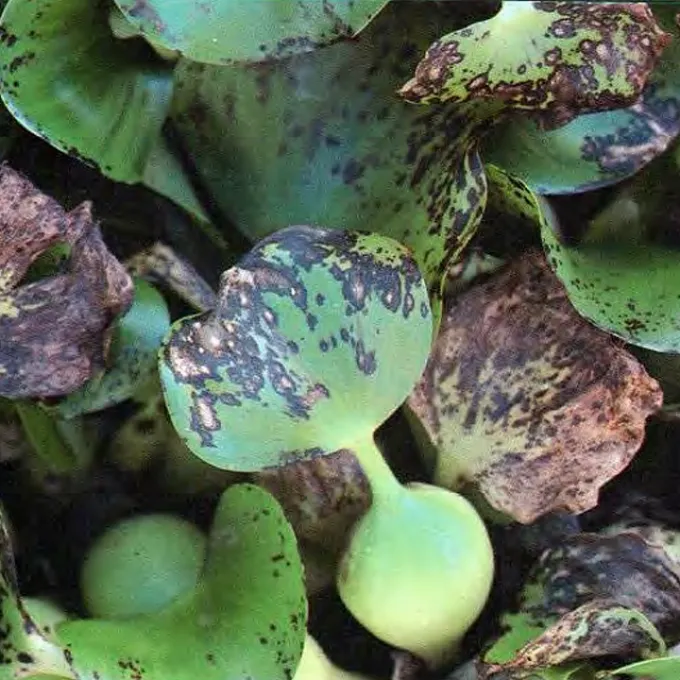
Description
Symptoms
Initial symptoms include small, chlorotic spots on the leaves, which gradually darken and turn into necrotic lesions ranging from brown to dark grey.
As the infection progresses, these lesions merge, covering large areas of the leaf blade and eventually causing the leaf tissue to wither and die prematurely.
Under humid conditions, a characteristic velvety growth consisting of fungal spores can often be observed on the surface of the lesions.
Severe infestation results in leaf deformation, stunted growth of the entire rosette, and eventual loss of buoyancy as the plant starts to decay and submerge.
- yellowing of leaf margins;
- development of dark necrotic spots;
- softening of leaf petioles;
- wilting and rotting of leaves;
- reduced plant density in mats.
Pathogen
The disease is caused by the fungus Cercospora rodmanii, which is a specialized pathogen targeting the invasive aquatic plant Eichhornia crassipes (water hyacinth).
The fungal mycelium colonizes the leaf tissues, secreting specific enzymes that break down plant cell structures to facilitate nutrient absorption and infection spread.
It produces asexual spores known as conidia, which are efficiently dispersed through water currents and wind, leading to rapid disease transmission within dense hyacinth mats.
This pathogen exhibits high host specificity, making it an excellent candidate for biocontrol as it poses minimal risk to non-target aquatic plants and surrounding ecosystems.
Research confirms that C. rodmanii is a naturally occurring agent that plays a critical role in limiting water hyacinth growth in its native and introduced ranges.
Conditions for development
Optimal development of Cercospora rodmanii occurs under conditions of high relative humidity and temperatures ranging between 20°C and 30°C.
Dense, stagnant mats of water hyacinth provide an ideal microenvironment, trapping humidity and allowing the fungus to spread rapidly between overlapping leaves.
Plant stress, often caused by nutrient limitations or overcrowding, renders the hyacinth more susceptible to fungal colonization, speeding up the disease cycle.
Periods of heavy rain contribute to the spread of conidia across the surface of the water, initiating new infection centers across the entire weed population.
Lack of water circulation helps maintain a stable environment for the fungus, ensuring that the pathogen remains active throughout the growing season.
Why it matters
The impact of this disease is significant, as it reduces the photosynthetic capacity of water hyacinth, thereby inhibiting its aggressive vegetative propagation.
By causing extensive tissue death, the fungus can effectively collapse large floating mats, clearing water surfaces and improving sunlight penetration.
Economically, C. rodmanii is viewed as a sustainable alternative to chemical herbicides, offering a method to clear clogged irrigation channels and reservoirs.
The damage caused by the fungus can weaken the weed population so severely that it may be easily eradicated or contained by secondary biological or mechanical factors.
It serves as an essential ecological regulator that helps restore the balance of biodiversity in aquatic habitats colonized by this invasive species.
Protection
Biological control programs involve the formulation and application of spore suspensions (mycoherbicides) directly onto water hyacinth mats.
Prevention and management require monitoring weed density, as thinner populations may be less conducive to the rapid spread of the disease.
Effective biocontrol relies on the use of highly virulent, laboratory-cultured strains of the fungus to ensure a strong impact on the targeted weed colonies.
Integrated management plans combine the application of the fungal pathogen with mechanical harvesting to manage the volume of decaying plant matter.
Proper environmental monitoring is necessary to ensure that the fungal application occurs during optimal weather windows to maximize efficacy and disease spread.
Discussion
No discussions yet — be the first.