
Take-all
Gaeumannomyces
The causative agent of take-all disease is the fungus Gaeumannomyces graminis. This soil-borne pathogen specifically targets the root system and the lower stem of cereal crops like wheat and barley.
What the section contains
Take-all
The fungus survives in the soil and on crop residues, specifically stubble, as mycelium. It can remain viable in the soil for several years, which presents a major challenge for cereal-intensive farming systems.
Infection spreads through the soil as mycelium grows along the roots of susceptible plants. When healthy roots come into contact with colonized organic matter or infected roots, the fungus easily colonizes them.
Upon infection, the mycelium invades the vascular tissues of the roots, effectively blocking the uptake of water and essential nutrients. This systemic damage leads to the characteristic stunted growth and eventual death of the plant.
The biology of Gaeumannomyces graminis is highly adapted to the rhizosphere, allowing it to maintain a parasitic relationship with cereals and a saprophytic phase on debris, ensuring survival during non-growing seasons.
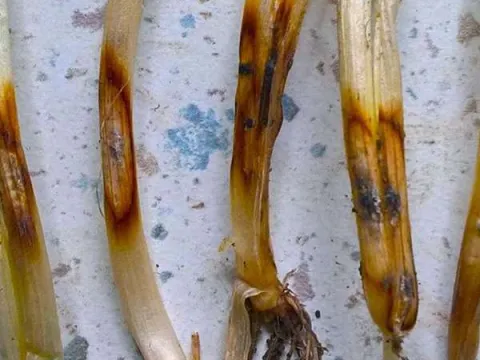
The most distinctive symptom of take-all is the blackening of the roots and the base of the stem, which is why it is often referred to as black root rot. This can be observed by inspecting the plant base.
During the early growth stages, infected plants are noticeably shorter than healthy ones, exhibiting stunted growth, yellowing (chlorosis), and general weakness.
As the plant approaches maturity, the disease manifests as the classic «whiteheads». The ears become bleached, empty, and grainless, as the destroyed root system fails to support grain development.
Close examination of the stem base often reveals a dense, black fungal mat under the leaf sheaths. This is a definitive sign of the pathogen's presence and activity.
In the field, the disease usually appears in patches. These patches often expand year after year if susceptible crops are continually grown, leading to distinct areas of dead or severely withered plants.
Take-all thrives in soils with neutral to alkaline pH levels. Higher soil pH values significantly increase the risk of severe outbreaks, as the pathogen prefers these conditions over acidic ones.
Moderate temperatures and high soil moisture are crucial for the rapid spread of the fungus. Warm, wet springs are particularly favorable for infection and the subsequent colonization of root systems.
Continuous cropping of cereals, especially wheat on wheat, leads to a significant buildup of the pathogen inoculum in the soil, which is the primary cause of severe field epidemics.
Poor soil structure, including compaction and inadequate drainage, creates stressful conditions for plants, making them much more susceptible to the fungal invasion.
The presence of grassy weeds, such as couch grass, allows the fungus to survive between cereal crops, acting as a green bridge that sustains the pathogen population.
Take-all is one of the most economically devastating root diseases in cereal production, capable of causing substantial yield losses that can exceed 40–50% in heavily infested fields.
The damage is primarily due to the severe reduction in grain size and weight. The grain produced by infected plants is often shrivelled and of very poor quality, significantly reducing market value.
The destruction of the root system renders the plants unstable, often leading to widespread lodging, which further complicates harvesting operations and increases field losses.
Beyond yield loss, the disease forces farmers to change their rotation plans, preventing the cultivation of high-value cereals for several years until the inoculum level in the soil drops.
The impact is also reflected in the lack of uniformity in the field, as the disease creates patchy, sparse stands that fail to maximize the utilization of fertilizers and other inputs.
The most effective strategy for managing take-all is the implementation of long-term crop rotation. Rotating cereals with non-host crops like legumes, oilseeds, or beets breaks the disease cycle.
Maintaining a clean field by controlling grassy weeds is essential, as these plants serve as hosts that harbor the pathogen during the rotation phase.
The use of physiologically acidic fertilizers, such as ammonium-based nitrogen, can help lower the pH of the soil in the rhizosphere, which creates an environment less favorable for the fungus.
Practices that promote the rapid breakdown of crop residues, such as proper tillage and soil aeration, are recommended to reduce the amount of inoculum available to infect the next season's crop.
Seed treatment with fungicides can provide some protection to the seedling stage, though it is often insufficient on its own if the soil inoculum pressure is extremely high.