
Take-all of oats
Gaeumannomyces avenae
The disease is caused by the fungus Gaeumannomyces avenae, a specialized soil-borne pathogen. It is a fungus that primarily infects the roots and basal stems of oat plants.
What the section contains
Take-all of oats
The pathogen survives in the soil and on crop residues as mycelium. It has a saprophytic phase, allowing it to persist in the field for several years without the presence of a host crop.
In the life cycle of the fungus, perithecia (fruiting bodies) develop on dead plant tissue. These structures produce ascospores, which are spread by wind and water splash to initiate new infections in the crop.
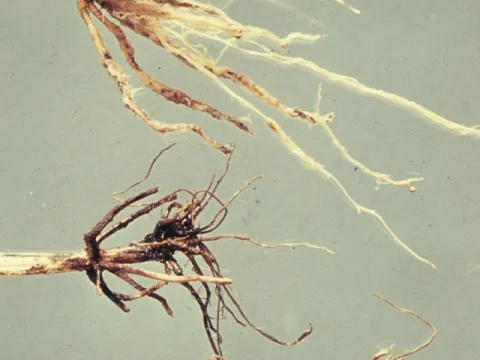
The fungus forms dark, runner-like mycelial hyphae that wrap around the roots. This physical encasement prevents the roots from functioning properly and interrupts the transport of water and nutrients.
While Gaeumannomyces avenae is most aggressive on oats, its ability to remain in the soil makes it a difficult pathogen to manage in intensive cereal-based rotations.
Initial symptoms are often observed as stunted growth in patches within the field during the tillering stage. Plants may appear chlorotic and exhibit uneven development compared to healthy areas.
The primary diagnostic feature is the severe darkening or blackening of the roots. Affected roots lose their structural integrity, become brittle, and can be easily broken when pulled from the soil.
A black, dense mat of mycelium can be found at the base of the stem, often hidden by leaf sheaths. This fungal growth is a key indicator of the disease and contributes to the weakening of the stem base.
Severe infections lead to the formation of 'take-all patches'—areas of the field where the crop dies prematurely. These patches can expand over consecutive growing seasons if host crops are continuously planted.
Plants affected by this root rot often exhibit a 'whitehead' symptom, where the grain fails to fill properly, resulting in shriveled kernels and significant reductions in yield and grain quality.
The development of take-all is heavily influenced by environmental conditions, with high soil moisture being the primary driver. Wet, cool-to-moderate conditions during spring favor the infection process.
The optimal temperature range for the pathogen's growth is between 15 and 20 degrees Celsius. Within this range, the fungus can rapidly colonize the root systems of susceptible oat seedlings.
Soil pH plays a critical role in disease severity, as the pathogen thrives in neutral to alkaline soils. Acidic soils tend to suppress the growth and activity of Gaeumannomyces avenae.
High levels of undecomposed straw in the soil provide the perfect substrate for the fungus to persist. Shallow tillage or no-till systems may increase the risk of disease carryover from one season to the next.
Low soil fertility, specifically deficiencies in phosphorus and potassium, can exacerbate the impact of the disease by weakening the plant's ability to develop a robust root system capable of resisting infection.
The primary harm is the destruction of the plant's root system, leading to physiological drought. Even when moisture is available, the plant cannot absorb sufficient water to support growth.
Take-all significantly reduces the density of the crop stands, which leads to increased weed competition and inefficient use of field space, ultimately resulting in lower overall farm productivity.
Grain harvested from infected fields is often of poor quality, characterized by low test weight and poor germination energy. This impacts the marketability of the product and its potential as seed for future planting.
The disease stress makes the crop more vulnerable to secondary infections by other pathogens and environmental stressors like extreme heat, which the plant might otherwise withstand.
In regions where wheat or oats are grown consecutively, take-all can lead to devastating economic losses, sometimes forcing farmers to switch to non-cereal crops for several years to break the infection cycle.
Effective management begins with strict crop rotation. Introducing break crops such as legumes, canola, or oilseed crops helps reduce the inoculum levels in the soil over time.
Cultural practices such as deep tillage to bury crop residues can speed up the decomposition process and reduce the survival of the fungus in the soil profile.
The use of acidifying fertilizers can help manage the soil pH, creating a less hospitable environment for the pathogen's development and spread.
Seed treatment with systemic fungicides is a standard practice to provide early-season protection to the developing seedling roots.
- Control of grass weeds that can serve as alternative hosts for the pathogen.
- Maintenance of balanced soil fertility to ensure strong plant health.
- Delayed planting in some regions to avoid peak moisture and temperature windows for infection.
- Monitoring fields for patch formation and mapping infected areas for future management adjustments.