
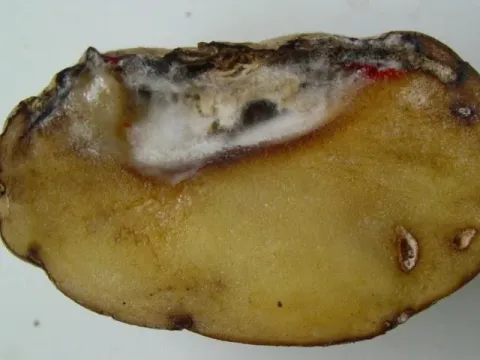
Fusarium dry rot of potato
Fusarium caeruleum
The causal agent of this disease is the fungus Fusarium caeruleum (along with other Fusarium species), classified within the Hyphomycetes group. This pathogen is known for its ability to persist in soil for long periods as chlamydospores.
What the section contains
Fusarium dry rot of potato
It acts as a facultative parasite, capable of surviving on both living host tissues and organic debris in the soil. The fungus exhibits remarkable environmental plasticity, allowing it to colonize various soil types effectively.
The primary inoculum typically originates from infested soil where mycelium survives on plant residues. Furthermore, the disease is frequently introduced into storage facilities via contaminated tubers harvested from infested fields.
The fungal mycelium enters potato tubers primarily through mechanical wounds, such as cuts, bruises, or cracks sustained during the harvesting or handling process. Once inside, the pathogen secretes toxins that cause tissue degradation.
While infection often initiates in the field on damaged tubers, the disease symptoms manifest most severely during the storage phase, where conditions are often optimal for fungal proliferation.
Initial symptoms are usually detected months after potatoes have been placed in storage. Externally, gray-brown sunken spots appear on the skin, which gradually expand as the disease progresses.
The flesh beneath these spots undergoes a drying process, losing moisture and turning into a powdery, crumbly mass. Unlike wet rots, the tissue remains relatively dry rather than turning into a watery pulp.
The skin over the affected area often shrivels and develops distinct concentric wrinkles. Internally, cavities form within the tuber, filled with loose mycelium that can be white, blue-white, or pinkish in color.
As the rot advances, the tuber loses significant weight and becomes hard and brittle. Under conditions of high humidity, tufts of fungal spores may emerge through the skin of the lesion.
In the final stages, the entire tuber becomes a light, desiccated mass of fungal growth, rendering it completely unsuitable for consumption or use as seed potatoes.
The development of Fusarium dry rot is highly favored by temperatures ranging from 15 to 25 degrees Celsius. Elevated temperatures during harvest and initial storage significantly accelerate the disease spread.
High relative humidity levels (above 80-85%) in storage facilities, coupled with poor air circulation, create the perfect microclimate for the rapid transmission of fungal spores between tubers.
Mechanical damage is the most critical predisposing factor. Fresh injuries sustained during mechanical harvesting, grading, or transportation provide the necessary entry points for the fungal infection.
Fluctuations in storage temperature that lead to condensation on the tuber surfaces significantly increase susceptibility to infection and exacerbate existing rot.
Harvesting in cool, wet conditions can also contribute to the prevalence of the disease, as tubers are often covered in soil and excess moisture that encourages pathogen activity.
Fusarium dry rot is recognized as one of the most destructive storage diseases of potatoes, capable of causing losses ranging from 20% up to 50% of the stored crop if preventive measures are ignored.
A major concern is the latent nature of the infection: tubers may appear completely healthy at the time of storage, only to show severe decay months later, complicating quality control.
Infected seed potatoes lead to poor plant emergence and stunted growth in the field, further contaminating the soil with the pathogen and jeopardizing future harvests.
The economic impact on the potato industry is substantial, involving not only the direct loss of volume but also the high labor costs associated with sorting and discarding spoiled produce.
Furthermore, the decay process produces volatile compounds and can facilitate secondary colonization by bacteria, further damaging the quality of the entire stored lot.
Effective management requires a comprehensive approach integrating good agricultural practices and strict sanitation protocols to minimize tuber injury.
- Application of appropriate fungicides to seed potatoes prior to planting.
- Vine killing 10-14 days before harvest to allow the potato skin to toughen.
- Rigorous disinfection of storage facilities before introducing new produce.
- Maintaining strict storage conditions at 2–4°C with controlled humidity.
- Regular inspections of stored potatoes to remove symptomatic tubers immediately.
A "curing" period is essential immediately after harvest, during which tubers are kept at moderate temperatures to allow wounds to suberize and develop natural protective barriers.
Optimizing storage ventilation is critical to prevent the accumulation of humidity and moisture, which are the primary drivers for the rapid spread of Fusarium spores throughout the storage pile.