
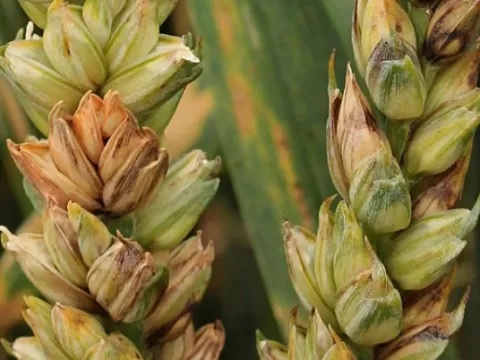
Fusarium head blight
Fusarium cerealis
The disease is caused by the fungus Fusarium cerealis, a member of the diverse Fusarium species complex. It is a filamentous fungus known for its significant impact on small grain cereals.
What the section contains
Fusarium head blight
This pathogen survives in crop debris, such as corn stalks or wheat stubble, and in the soil. It can persist for long periods, waiting for favorable conditions to infect host plants.
The life cycle of Fusarium cerealis involves the production of spores called conidia, which are disseminated by wind and rainfall. These spores land on the heads of cereals during the flowering stage.
Once infection occurs, the fungus colonizes the spike tissues, producing harmful secondary metabolites known as mycotoxins. These toxins, including deoxynivalenol, can severely impair grain quality.
The fungus is highly resilient, and its ability to infect multiple cereal hosts ensures its prevalence across various agricultural environments where susceptible crops are grown in rotation.
The most visible symptom of Fusarium head blight is the premature bleaching of parts of the grain head. This bleaching often contrasts sharply with the healthy, green tissues of the plant.
Under humid conditions, a pink or orange fungal growth (sporulation) appears at the base of the spikelets. This is a diagnostic sign of the presence of the pathogen on the infected tissue.
The infected kernels inside the head often become shriveled, discolored, and covered with white or pink mycelium. This leads to the condition commonly referred to as "tombstone" grains.
In severe cases, the entire head may become blighted, leading to a loss of grain weight and poor test weight. The infection can spread downwards from the initial point of entry on the head.
Early diagnosis is essential, as the infection is often localized initially, but the fungal mycelium can quickly spread through the rachis, causing the entire head to die prematurely.
The development of Fusarium head blight is heavily dependent on wet weather. Periods of high humidity, particularly during the flowering of wheat or barley, are critical for infection.
Temperatures ranging from 20 to 25 degrees Celsius, combined with frequent rainfall or heavy dew, create the perfect conditions for the spores to germinate and infect the spikelets.
Agricultural practices also influence the severity of the disease. Planting wheat in fields with high levels of previous crop residues, like corn, significantly increases the local inoculum pressure.
Lack of proper field rotation contributes to the build-up of the pathogen in the soil, ensuring that the next crop of susceptible cereals will be exposed to a higher load of fungal spores.
Dense crop stands can inhibit proper air circulation within the canopy, leading to a moist microclimate that encourages the spread of the fungus throughout the field.
The primary damage caused by Fusarium head blight is yield loss, which can be substantial. Infected heads produce light, shriveled, and low-quality grains that are difficult to harvest.
Beyond yield reduction, the contamination of grain with mycotoxins poses serious health risks. These toxins are toxic to both humans and livestock, making the grain unsuitable for food or feed.
Grain quality is severely compromised, often failing to meet market standards. This results in heavy economic losses for farmers due to price deductions or the total rejection of the harvest.
The presence of infected seed reduces germination rates and vigor, leading to poor crop establishment and thin stands in the following season, which negatively impacts overall farm productivity.
Increased costs are incurred due to the need for harvesting adjustments, grain cleaning, and the constant threat of toxin contamination, all of which contribute to higher production expenses.
Implementing a crop rotation system that avoids susceptible hosts is the most effective cultural practice. Growing non-host crops helps break the infection cycle of the pathogen.
Tillage practices that bury crop residues help speed up the decomposition of the organic matter, reducing the amount of inoculum available to infect the current season's crop.
Fungicide application during the early flowering phase is a critical strategy. Systemic fungicides are necessary to protect the grain heads during the window when they are most susceptible to infection.
Choosing resistant or tolerant varieties is a vital long-term strategy for managing Fusarium head blight, providing a baseline of protection even in years with high disease pressure.
Using high-quality, treated seed is essential to prevent seedling blight and ensures that the crop starts with a low disease profile, minimizing the spread of the fungus within the field.