
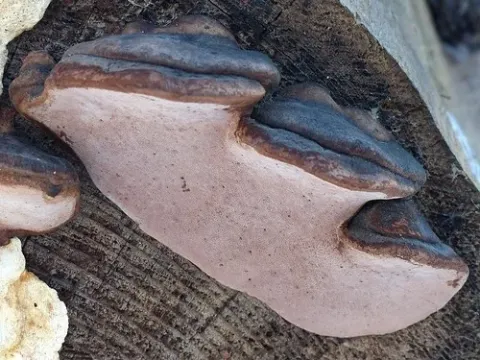
Fomitopsis rosea
Fomitopsis rosea
The causative agent of the disease is the fungus Fomitopsis rosea, which belongs to the Basidiomycetes phylum. It is a wood-decaying fungus that causes intense brown rot in coniferous wood species.
What the section contains
Fomitopsis rosea
Biologically, this species is characterized by its ability to penetrate tree trunks through mechanical damage to the bark, cracks, or broken branches. The mycelium spreads through the wood, decomposing cellulose while leaving the lignin intact.
The fruit bodies of the fungus are perennial, sessile, and have a characteristic hoof-like or resupinate-reflexed shape. Their upper surface is distinguished by a bumpy texture and gray-brown color.
The lower surface of the fruit body has a distinct pink or salmon hue, which gave the fungus its species name. The pores are small and rounded, which helps in identifying the species during field inspection.
The life cycle of the fungus is closely linked to wood degradation, during which it actively releases spores to infect new substrates, most often in old or weakened forest stands.
The main external sign of infestation is the presence of typical hoof-like fruit bodies on the trunks of dead or fallen trees. They are located singly or in small clusters.
The internal stage of the disease manifests as a deep transformation of the wood. The affected tissue takes on a dark, reddish-brown hue, becoming brittle and disintegrating into cubes.
As the disease progresses, the wood loses its structural integrity, which often leads to windthrow and breakage of trunks even under moderate wind loads.
In the cracks of the rotten wood, one can often see the development of mycelium — whitish or cream-colored films that indicate the active phase of decomposition.
In the final stages, the tree loses viability, the bark begins to peel off, and the overall mass of the trunk decreases significantly due to enzymatic destruction of cell walls.
Fomitopsis rosea is an inhabitant of old-growth coniferous forests. The fungus prefers spruce wood, less frequently found on fir or pine under high humidity conditions.
A key factor for development is the presence of a sufficient amount of fallen logs, stumps, and large standing dead trees, which serve as a primary substrate for spore formation.
Favorable conditions are created in dense stands with limited air circulation, where wood moisture is maintained at a level necessary for the germination of basidiospores.
The fungus is highly sensitive to temperature regimes, preferring the cool, temperate climate characteristic of northern regions and mountain forest massifs.
Disruption of the natural hydrological regime in forest ecosystems or damage to trees by pests significantly accelerates the colonization of wood by this pathogen.
The harmfulness of Fomitopsis rosea lies in the reduction of quality characteristics of wood raw materials. Rot makes the wood completely unsuitable for industrial use as building material.
The fungus is a dangerous risk factor for forestry, as it contributes to the premature decline of forest stands and loss of productivity in forest lands.
Affected trees become hotspots for spore distribution, which creates a threat to healthy but weakened trees in the immediate vicinity of the outbreak epicenter.
In specially protected natural areas, the fungus plays a dual role, acting simultaneously as a decomposer participating in nutrient cycling and as a pathogen for valuable forest species.
Economic damage is caused by the necessity of conducting sanitary logging and the loss of timber inventory, which, as a result of destruction, becomes non-commercial deadwood.
The main method of protection is the implementation of timely sanitary logging aimed at removing infected trees and deadwood, which serve as a source of infection.
It is important to limit damage to tree bark during forestry operations, as wounds are the primary entry point for fungal spores into living tissue.
It is necessary to maintain optimal stand density, ensuring timely forest care to prevent the formation of deadwood and rot outbreaks.
For preventive purposes, it is recommended to leave only the necessary amount of deadwood in the forest to support biodiversity, while isolating areas with massive infestation.
- Monitoring the condition of forest massifs during the autumn period.
- Timely disposal of infected wood from the site.
- Use of selected resistant seedlings during reforestation.