
Entomophthorales
Entomophthorales
Entomophthorales is an order of fungi that are specialized pathogens of arthropods. In an agricultural context, they are not considered a plant disease but rather natural biological control agents that regulate pest populations such as aphids, mites, and thrips.
What the section contains
Entomophthorales
These fungi are obligate parasites, meaning they depend entirely on their insect host to complete their life cycle. They infect their hosts by penetrating the cuticle and invading the internal tissues, eventually killing the insect.
The life cycle involves both asexual reproduction, producing conidia for rapid spread, and sexual reproduction, which creates durable resting spores capable of surviving environmental extremes.
High host specificity is a hallmark of this group. Many Entomophthorales species target narrow groups of insects, which makes them highly valuable for targeted biological control without disrupting beneficial insect populations.
From an agronomic perspective, these fungi represent a key component of ecosystem services, providing natural suppression of pest outbreaks that can reduce the need for chemical intervention.
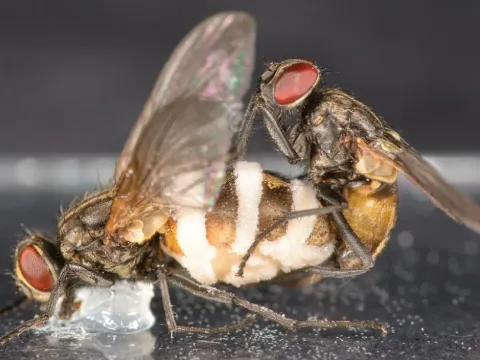
The primary sign of infection is the sudden mortality of pests within a colony. Dead insects are often found fixed to the host plant leaves or stems by fungal mycelia.
Infected insects typically exhibit discoloration, loss of mobility, and a fixed posture, often with the abdomen elevated. This is a behavioral manipulation that maximizes the distribution of fungal spores.
A visible layer of fungal growth (white or grey) often appears on the cadaver of the insect, consisting of conidiophores and spores, which are then dispersed by wind or rain splash.
Microscopic examination reveals fungal hyphae within the host tissues, where the fungus has consumed the internal organs and replaced them with mycelial mass.
In field observations, a mass epizootic event is characterized by a significant decrease in the pest population and the presence of numerous mummified insects clinging to the crop canopy.
High relative humidity is the most critical environmental factor for the development and spread of Entomophthorales. Humidity levels above 80% create an ideal environment for spore germination and infection.
Moderate temperatures, typically between 18°C and 24°C, are optimal for fungal growth. Temperatures exceeding 30°C generally inhibit development and can halt an ongoing epizootic event.
Crop density significantly influences the local microclimate. Denser canopies maintain higher humidity levels for longer periods, facilitating the transmission of fungal spores from one insect to another.
Rainy weather or heavy dew is essential for the activation of spores on the surface of the insect cuticle, acting as a catalyst for the initial infection process.
Population density of the pest also drives the spread. When insects are closely grouped together, the fungus can spread more rapidly, leading to the rapid collapse of the pest colony.
The primary concern for agronomists is the misidentification of natural mortality as an effect of insecticide application, leading to incorrect assessment of chemical efficiency.
While beneficial to pest control, some species can infect non-target organisms, including pollinators or beneficial predators. Assessing the fungal species present before applying any biological control product is recommended.
Excessive use of broad-spectrum fungicides can inadvertently eliminate these beneficial fungi, leaving the crop vulnerable to future pest attacks without the protective buffer provided by natural biological agents.
The reliance on these fungi as a sole control method can be risky because epizootics are highly dependent on weather conditions and can fail if the environment becomes hot and dry.
Entomophthorales themselves do not cause harm to crop plants, but their presence indicates an active ecosystem that requires careful management to preserve the natural balance.
Preservation of these fungi involves reducing the frequency of broad-spectrum fungicide applications and adopting Integrated Pest Management (IPM) practices that respect natural biocontrol processes.
Decision-making regarding pest control should include a pre-treatment survey. If a significant proportion of the pest population is found to be infected, chemical control measures might be unnecessary.
- Maintaining field margins to preserve biodiversity.
- Avoiding unnecessary prophylactic chemical sprays.
- Optimizing plant spacing to manage microclimate humidity.
- Using selective pesticides that are non-toxic to fungal biocontrol agents.
- Training field staff to identify signs of natural fungal mortality.
Integrating biological monitoring into standard agronomic practices allows for more precise intervention timing, ensuring that natural fungal cycles are supported rather than disrupted.
When applying bio-fungicides based on Entomophthorales, strictly follow environmental requirements for application to ensure the spores remain viable and effective in the field.