
Entomophthorosis
Entomophthora
Description
Symptoms
The initial sign of infection is a change in the behavior of the pest. Infected insects often cease feeding, become lethargic, and exhibit a positive phototaxis, moving to the top of the plant to facilitate spore dispersal.
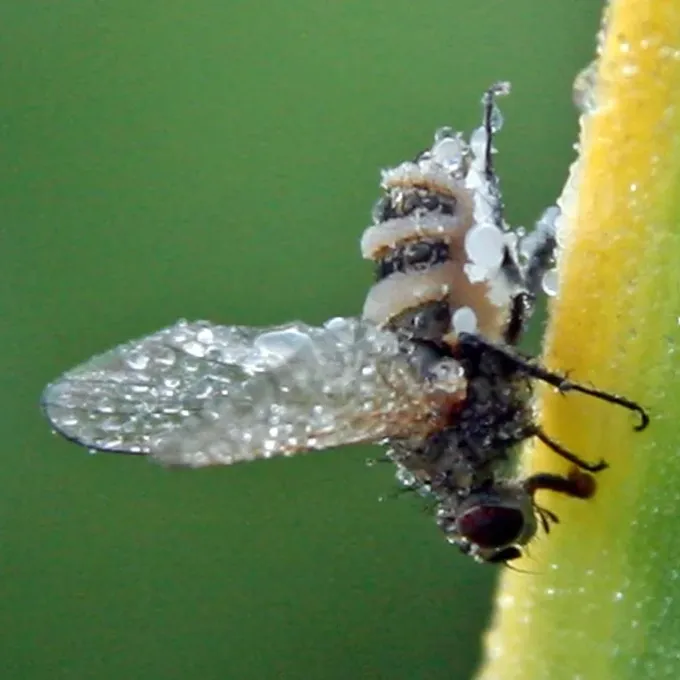
A dead insect killed by this fungus is often found firmly attached to the plant surface. This attachment is mediated by rhizoids or specialized mycelial structures that anchor the cadaver to the leaf or stem.
Under high humidity, the insect cadaver becomes covered in a dense, fuzzy layer of spores. This layer can appear white, yellow, or grey depending on the specific species of the fungus involved.
When observing a colony of aphids or other small pests, the presence of entomophthorosis is indicated by a mass mortality event where numerous individuals are found dead in close proximity, covered in fungal bloom.
Microscopic examination of the host's internal tissues reveals the characteristic rounded protoplasts of the fungus. This confirms that the death was caused by an entomophthoralean infection rather than a viral or bacterial pathogen.
Pathogen
Entomophthorosis is a disease caused by fungi belonging to the order Entomophthorales. These fungi are specialized obligate parasites that infect a wide range of arthropods, primarily insects, rather than plants.
The life cycle begins when conidia, the asexual spores, land on the host's cuticle. These spores germinate and produce specialized structures that enzymatically digest the insect's exoskeleton to enter the hemocoel.
Inside the host, the fungus grows rapidly as protoplasts, absorbing nutrients from the insect's hemolymph. This causes the gradual cessation of the host's physiological functions, leading to death.
These fungi are known for their high host specificity. Each species within the Entomophthora genus typically targets a specific group of insects, which makes them highly effective and environmentally safe biological control agents.
After the host dies, the fungus produces new conidiophores that emerge through the intersegmental membranes of the insect. These structures forcefully discharge new spores into the environment to perpetuate the infection cycle.
Conditions for development
High relative humidity is the most critical environmental factor for the successful spread of entomophthorosis. Optimal infection typically occurs when humidity levels exceed 90%, often following heavy rain or dew.
The temperature range for optimal development usually falls between 18°C and 25°C. Extreme temperatures, whether very cold or excessively hot, can significantly inhibit the germination and growth rates of the fungus.
High host population density is essential for the rapid spread of the disease. In dense colonies, the probability of successful spore transmission between healthy and infected individuals is exponentially higher.
Solar radiation can be detrimental to the spores. Consequently, many species have evolved to release their conidia during the night or early morning hours to maximize their survival and infection efficiency.
The presence of sheltered microclimates within the crop canopy, such as areas with thick foliage, provides the necessary humidity buffer for the fungus to persist and infect new hosts even in less-than-ideal weather.
Why it matters
Entomophthorosis is not a disease of plants; it is a natural biological control agent. Therefore, it causes no harm to crops and is considered highly beneficial in agricultural systems.
The primary effect of this fungal activity is the rapid reduction of pest populations. This decreases the overall pressure on the plants, leading to better crop health and potentially higher yields.
Unlike chemical pesticides, entomophthorosis has a minimal impact on non-target species, including pollinators and beneficial predatory insects, which is a major advantage for sustainable farming practices.
The only limitation is that it is not a "quick fix" or a controllable spray; it is a naturally occurring phenomenon that relies entirely on favorable ecological and weather conditions to suppress pests.
In well-managed agroecosystems, the presence of these fungi provides a natural form of pest resistance that reduces the dependency on synthetic insecticides and lowers the cost of production.
Protection
To encourage natural entomophthorosis, it is essential to maintain high biodiversity within the field. Maintaining hedge-rows and undisturbed wild plant margins provides refuge for insects and promotes the cycling of fungal spores.
Avoid the prophylactic use of broad-spectrum fungicides, as these chemicals can inadvertently kill beneficial entomopathogenic fungi and disrupt the natural biological balance of the agroecosystem.
Monitoring the fields for signs of epizootics is crucial. If a significant portion of the pest population is already showing symptoms of infection, farmers should consider skipping an insecticide application to avoid destroying the natural control agents.
Research into the mass production of these fungi as bio-insecticides is ongoing, although field application remains challenging due to the specific humidity requirements of the living spores.
- Preserve crop residue to allow resting spores to survive until the next season.
- Minimize pesticide drift into non-crop areas to protect fungal reservoirs.
- Use integrated pest management (IPM) to track the prevalence of mycoses in pest populations.
Discussion
No discussions yet — be the first.