
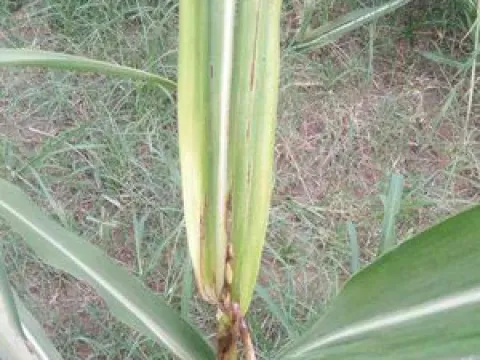
Sugarcane leaf blight
Mycosphaerella striatiformans
The primary symptom of sugarcane leaf blight is the appearance of narrow, elongated stripes on the leaves that initially display a pale green or yellowish hue.
What the section contains
Sugarcane leaf blight
Over time, these characteristic stripes turn brown or dark necrotic, indicating the death of plant tissues caused by the fungal pathogen.
Affected leaves often show signs of premature drying and curling, which disrupts the plant's ability to perform photosynthesis efficiently.
In the later stages, the underside of the affected leaf areas may show fungal sporulation, which appears as small dark spots or a fine dusty coating.
Widespread infection leads to stunted plant growth, reduced stalk diameter, and significant weakness in the overall development of the sugarcane clump.
The disease is caused by the fungus Mycosphaerella striatiformans, which belongs to the class of Ascomycetes and acts as a parasitic agent.
This pathogen specifically infects sugarcane foliage by entering through natural openings like stomata or through various mechanical abrasions on the leaf surface.
Upon penetration, the fungus colonizes the leaf tissues, secreting enzymes that break down plant cell structures to acquire nutrients for its growth.
The pathogen reproduces via conidia, which are easily disseminated by wind currents, splashing rain, and agricultural machinery working in the fields.
The survival of the fungus is highly dependent on crop residues, where it can persist during off-seasons, providing an inoculum for the next crop cycle.
High relative humidity and frequent rainfall are the most critical environmental factors that promote the infection and spread of the fungus.
Warm temperatures, ranging between twenty and twenty-eight degrees Celsius, provide the ideal metabolic conditions for the fungus to multiply and spread.
Fields with dense plant spacing lack sufficient air circulation, creating a microclimate that traps moisture and favors the development of leaf blight.
The presence of free moisture from dew or fog on the leaf surfaces acts as a catalyst for spore germination and facilitates successful leaf infection.
Poor agricultural practices, such as failing to remove infected leaves or crop debris, significantly increase the disease pressure within the plantation.
The economic impact of this disease is significant, primarily due to the reduction of photosynthetic area, which leads to lower yields of biomass.
Sugarcane leaf blight interferes with sucrose accumulation in the stalks, resulting in lower sugar content and poorer quality of the harvested raw material.
Severe outbreaks can cause extensive leaf necrosis, leading to plant exhaustion and increased susceptibility to secondary infections or environmental stress.
Processing plants face difficulties due to the degraded quality of the cane juice, which can complicate the milling and sugar extraction processes.
If left unmanaged, the pathogen can quickly spread throughout a farm, causing substantial financial losses and requiring costly control measures.
Selecting and planting resistant or tolerant sugarcane varieties is the most effective long-term strategy for managing leaf blight outbreaks.
Field sanitation remains a cornerstone of prevention, including the thorough removal or deep burial of all crop residues after harvest.
Fungicide applications, when timed correctly during the early stages of disease development, can help suppress fungal spread and protect healthy leaves.
Maintaining adequate row spacing ensures better airflow and lower humidity, which effectively discourages the growth and colonization of the fungus.
- Implementation of a strict crop rotation program.
- Monitoring fields for the first signs of necrotic stripes.
- Ensuring nutrient balance to enhance the plant's natural defense systems.