
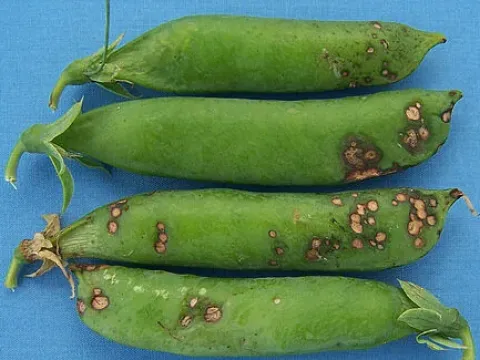
Pea Ascochyta blight
Didymella pinodella
The fungus Didymella pinodella is the primary pathogen responsible for Ascochyta blight in pea crops worldwide.
What the section contains
Pea Ascochyta blight
This pathogen survives as mycelium or pycnidia in soil, crop residues, and infected seed lots, posing a long-term threat to production fields.
It has a broad host range within the legume family, affecting peas, lentils, chickpeas, and vetches, which complicates crop rotation planning.
The life cycle involves the production of conidia that are splashed onto healthy plant tissues by raindrops during wet weather.
The ability of this fungus to persist in agricultural soils for several years makes it a difficult challenge for sustainable farming systems.
Symptoms appear as dark, circular or irregular lesions with lighter centers and darker margins on leaves, stems, and pods.
Tiny black dots, known as pycnidia, can often be observed within the necrotic tissue of these lesions under magnification.
Stem infections typically manifest as dark brown streaks or girdling near the soil line, often causing lodging and plant death.
Pod infection results in sunken, reddish-brown spots, which can lead to the transmission of the fungus into the developing seeds.
Root rot symptoms can occur, leading to stunted plant growth, chlorosis, and the overall decline of the crop canopy in early stages.
Warm and moist weather conditions are essential for the rapid germination of spores and the development of the fungal mycelium.
The spread of the disease is highly correlated with frequent rainfall and high relative humidity levels during the growing season.
Crowded plant stands facilitate the rapid transmission of the pathogen, as the microclimate within the canopy remains humid for longer periods.
Cooler spring temperatures combined with wet soil are particularly favorable for seedling infection and subsequent root rot development.
Poor drainage in fields leads to increased disease pressure, as waterlogging weakens the plants and favors fungal proliferation.
Pea Ascochyta blight causes severe yield losses through seed weight reduction, lower germination rates, and premature plant senescence.
The cosmetic damage to seeds lowers their commercial value, making the harvest unsuitable for human consumption or high-quality export.
Reduction in the leaf surface area inhibits photosynthesis, negatively impacting the plant's ability to fill pods effectively.
In cases of severe infection, entire patches of the crop may be destroyed, resulting in significant gaps in the field population.
The economic impact also includes increased production costs due to the need for repeated fungicide applications and management efforts.
The most reliable control strategy is the use of high-quality, certified pathogen-free seeds treated with effective fungicides.
Implementing a long-term crop rotation strategy of at least 4 years between pea crops is crucial to break the fungal life cycle.
Deep tillage helps to incorporate infected plant debris into the soil, promoting faster decomposition and reducing inoculum levels.
Foliar application of fungicides during the flowering and pod-filling stages can effectively limit the progression of the blight.
- Selection of resistant or moderately tolerant pea cultivars.
- Strategic management of weeds that can host the pathogen.
- Optimizing planting density to ensure proper air circulation.
- Avoiding fields with high moisture retention for pea production.