
Pea downy mildew
Peronospora viciae
Description
Symptoms
The first symptoms of pea downy mildew appear as pale yellow or chlorotic spots on the upper surface of the leaves. These spots are often irregular and may vary in size depending on the level of infection.
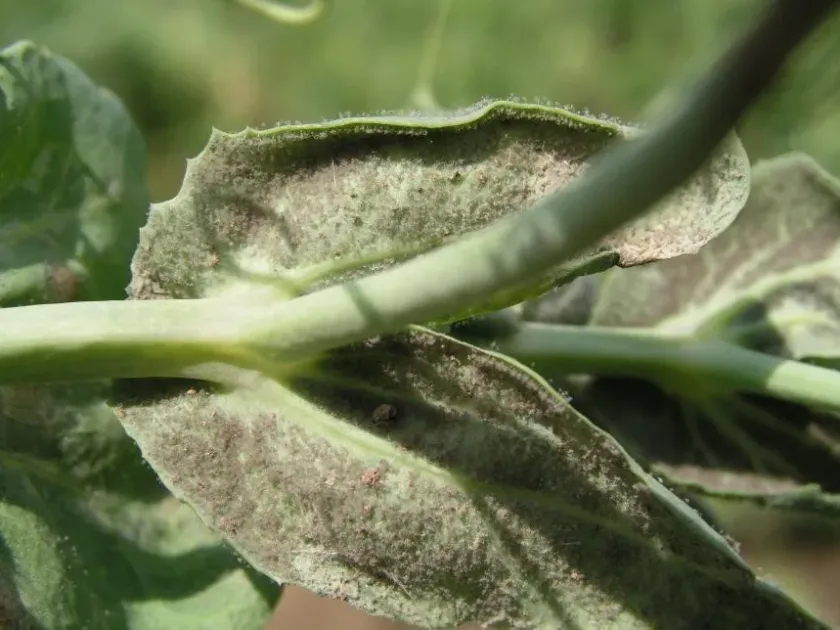
Under humid conditions, a characteristic greyish-purple downy growth forms on the underside of the leaves, directly opposite the yellow spots. This is the sporulation of the pathogen.
As the disease progresses, these spots turn brown and necrotic. The tissue dies, leading to the curling, yellowing, and premature shedding of the foliage.
Severe infections can cause visible stunting of the plants. If the infection reaches the stems or pods, lesions may form, potentially causing deformation or pod abortion.
In heavily infested fields, the crop may appear sparse due to early leaf loss, which drastically reduces the canopy density and plant vitality.
Pathogen
The causative agent of pea downy mildew is the oomycete Peronospora viciae. It is an obligate parasite, meaning it requires living host tissue to survive and reproduce.
The pathogen survives in the soil through oospores, which are highly resilient and can remain viable for several years, even in the absence of a host crop.
Primary infection often starts from infected seeds, where the fungus persists as mycelium. Once the plant emerges, the pathogen initiates systemic or localized infection.
Secondary spread occurs through conidia (sporangia) produced on the underside of leaves. These spores are easily disseminated by wind, rain, and irrigation water to neighboring plants.
The biological cycle is rapid, especially during favorable weather, allowing the fungus to build up high levels of inoculum in the field within a few weeks.
Conditions for development
Cool and damp weather conditions are ideal for the development of Peronospora viciae. Temperatures between 10°C and 18°C are considered optimal for sporulation.
High relative humidity and the presence of leaf moisture, such as dew or light rain, are essential for the germination of the conidia and the penetration of the host tissue.
Dense plant populations limit airflow within the crop canopy, creating a microclimate that remains humid for longer periods, which significantly promotes disease outbreaks.
Poorly drained soils or excessive irrigation can contribute to the severity of the disease by maintaining high humidity around the lower parts of the plants.
Late sowing in cold, wet conditions often exposes young seedlings to early infection, which can lead to higher cumulative damage throughout the growing season.
Why it matters
The primary economic harm of downy mildew is the reduction in photosynthetic area, which directly results in lower plant biomass and final yield.
Infected plants produce smaller, shriveled seeds, leading to a reduction in the quality and market value of the harvested crop.
Yield losses can be substantial, especially when the disease occurs during the flowering and pod-filling stages, potentially reducing yields by up to 30%.
The disease weakens the plants, making them more susceptible to opportunistic pathogens and other environmental stressors that further inhibit growth.
Reduced seed vigor can also lead to poor emergence in subsequent seasons if infected seeds are used for planting, creating a cycle of disease persistence.
Protection
The most effective strategy for managing downy mildew is a long crop rotation of at least 4–5 years to break the infection cycle in the soil.
Using certified, disease-free seed and applying appropriate seed treatments can significantly reduce the risk of introducing the pathogen into the field.
Choosing resistant or tolerant pea varieties is a key component of integrated pest management and provides a robust defense against the disease.
Good field hygiene, including the deep plowing of crop residues, helps bury inoculum and speeds up its decomposition, limiting the source of primary infection.
- Maintain optimal plant spacing to improve air circulation.
- Use fungicides in susceptible areas if early symptoms appear.
- Improve soil drainage to prevent stagnant moisture.
- Balance fertilization to enhance plant physiological resistance.
Discussion
No discussions yet — be the first.