
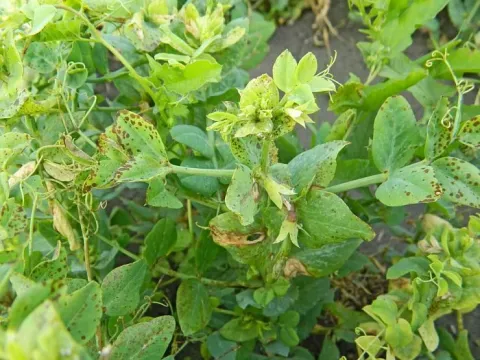
Pea early browning
Pea early
The causative agent of pea early browning is the Pea early browning virus (PEBV), a member of the Tobravirus genus.
What the section contains
Pea early browning
This pathogen contains a single-stranded RNA genome and is characterized by a very wide host range, which makes its spread in agricultural landscapes difficult to manage.
The virus is transmitted both mechanically through field operations and biologically by soil-borne nematodes of the genera Trichodorus and Paratrichodorus.
Beyond peas, the virus affects a broad spectrum of crops and wild plants, including beans, alfalfa, lettuce, and vegetable crops such as pepper.
The virus persists in the resting spores of its nematode vectors or within the roots of perennial weed hosts, making crop rotation an essential component of disease management.
Initial symptoms include chlorotic spots and streaks on the leaves of young plants, which subsequently turn brown as the infection progresses.
Shoot tips frequently become distorted and necrotic, leading to stunted growth and severe dwarfing of the affected pea plants.
Brown streaks may appear on stems, which eventually coalesce, causing premature browning and tissue death of the entire plant structure.
In peppers, the virus manifests as leaf mottling, fruit deformity, and a significant overall reduction in plant productivity and vitality.
In field settings, the disease often appears in localized patches, corresponding to the distribution of nematode populations within the soil profile.
Cool and moist weather conditions during the spring favor the activity of nematode vectors, thus promoting the rapid spread of the disease.
Light sandy or sandy-loam soils provide an ideal habitat for nematode reproduction, leading to an increased risk of infection on these soil types.
A high density of nematodes in the rhizosphere significantly accelerates the transmission of the virus to young seedlings during early development.
Early planting dates, when soil temperatures are low, can prolong the exposure of germinating seeds to infected nematodes in the soil.
Inadequate agronomic practices that encourage the buildup of weed reservoirs contribute significantly to higher infection levels in subsequent seasons.
The disease causes substantial economic losses by reducing both the yield volume and the quality of the harvested grain legumes.
Infection disrupts photosynthesis and nutrient translocation, which adversely affects seed filling and impairs overall plant development.
Pea early browning often results in crop lodging and seedling mortality, which may necessitate the replanting of large areas of the field.
Produce from infected fields often lacks marketability due to quality degradation, leading to direct financial deficits for agricultural producers.
The persistence of the virus and its vectors in the soil limits the viable options for rotating susceptible legumes on the same land for several years.
Implementing a robust crop rotation strategy is the primary defense, ideally ensuring that host legumes do not return to the same plot for at least five years.
Aggressive weed control is critical to eliminate alternative host plants, which serve as reservoirs for both the virus and its nematode vectors.
Breeding and selecting resistant or tolerant pea varieties remain the most sustainable and cost-effective approach to mitigating disease impact.
Soil treatment with nematicides can be effective but is often constrained by high input costs and strict environmental safety regulations.
- Conducting regular field health monitoring.
- Managing soil nematode population density.
- Optimizing planting schedules for rapid crop establishment.
- Maintaining high standards of agronomic field management.