
Chrysothrix candelaris
Chrysothrix candelaris
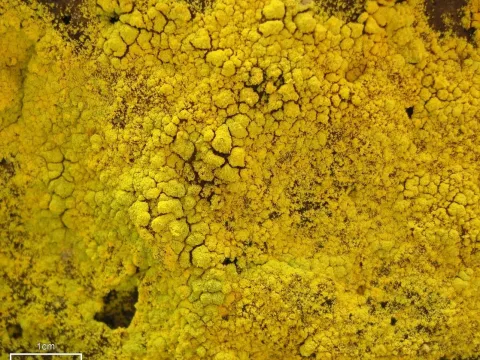
Chrysothrix candelaris appears on tree trunks and branches as vibrant, powdery patches ranging from golden-yellow to sulfur-yellow. Unlike foliose lichens, it is a crustose species that adheres tightly to the substrate, forming a granular, dust-like coating.
What the section contains
Chrysothrix candelaris
A distinctive feature is the lack of visible, distinct lobes. The surface of these patches looks like a thin, loose, sulfur-colored powder that can be easily rubbed off by mechanical friction. It is most often found within deep bark fissures.
In cases of heavy infestation, the colonies may merge to cover large areas of the trunk and primary branches. The color is most intense during damp weather, making the lichen clearly visible on the bark surface.
Typically, this species does not form prominent fruit bodies (apothecia), which makes identification difficult without careful inspection of its granular structure. It is often mistaken for simple dust or a harmless surface deposit.
Infestation usually starts in areas where moisture remains trapped for long periods, slowly spreading across the bark as the colony grows and releases reproductive structures.
Chrysothrix candelaris is a symbiotic organism belonging to the Lecanoraceae family. It consists of a fungal partner (mycobiont) providing structural support and green algae (phycobiont) performing photosynthesis.
This lichen is an epiphyte, not a parasite. It uses the tree bark as a physical support for growth rather than extracting nutrients from the tree tissues. It survives on minerals from rain, dust, and organic debris.
Reproduction is primarily vegetative, occurring through soredia—microscopic clusters of algal cells wrapped in fungal hyphae. These particles are easily dispersed by wind, rain, or insects to colonize new bark surfaces.
The biology of the organism is well-adapted to moderate light and consistent moisture levels. It can withstand periods of desiccation by entering a dormant state until conditions become favorable again.
The presence of this lichen is a significant indicator of the tree's health and the local environment. Its appearance suggests that the tree canopy may be too dense, lacking adequate ventilation or light.
The development of Chrysothrix candelaris is favored by older trees with rough, fissured bark. Such surfaces provide the ideal environment for trapping spores, moisture, and dust, which are essential for its initial establishment.
Thickly planted orchards with poor air circulation create the perfect microclimate for lichen growth. Consistently high air humidity is the primary driver for the expansion of these colonies.
The presence of dead bark tissue and weakened branches significantly accelerates colonization. Trees that do not receive regular sanitary pruning are much more likely to host large colonies of this lichen.
Sunlight exposure plays a dual role: while it prefers partial shade, it thrives where light meets damp bark. Solar energy stimulates the algal component, allowing the lichen to spread rapidly across the trunk.
Neglecting maintenance, such as failing to remove organic debris from the crotches and fissures of trees, provides an abundant nutrient base for the lichen to establish itself and thrive.
While not a direct pathogen, Chrysothrix candelaris can impede bark respiration. A dense layer of lichen acts as a physical barrier that restricts gas exchange, which can lead to the physiological weakening of the tree tissue.
The lichen layer tends to trap excessive moisture against the bark, creating a humid microenvironment that promotes the development of wood-rotting fungi and other secondary infections.
These patches often serve as hiding spots for garden pests, including scale insects and mites. The lichen provides them with shelter from natural predators and acts as a barrier against pesticide applications.
A mass presence of this lichen serves as a warning sign of a stressed or weakened tree. If left unmanaged, the tree may experience reduced vigor, leading to lower fruit yields and a shorter lifespan.
Over time, the cumulative effect of obstructed gas exchange and trapped moisture can result in premature bark cracking and the decline of individual scaffold branches, requiring corrective pruning.
Mechanical removal is the first step in control. Using a stiff brush or a specialized scraper allows for the removal of the lichen layer without damaging the underlying live bark tissue.
Once the bark is cleaned, it should be disinfected with a 3–5% solution of ferrous sulfate. This kills any remaining lichen fragments and helps prevent the germination of fungal spores in bark fissures.
Regular sanitary and thinning pruning is essential. By opening the canopy to better light and air circulation, the bark dries out faster, creating an environment that is hostile to further lichen colonization.
Whitewashing the trunk and the base of the primary branches with a lime-based solution containing copper sulfate creates a protective, alkaline barrier that discourages lichen attachment.
- Systematic removal of dead or decaying branches.
- Enhancing tree immunity through balanced fertilization and care.
- Targeted pest control to eliminate hiding spots beneath the lichen.
- Maintaining proper spacing between trees to ensure adequate airflow.