
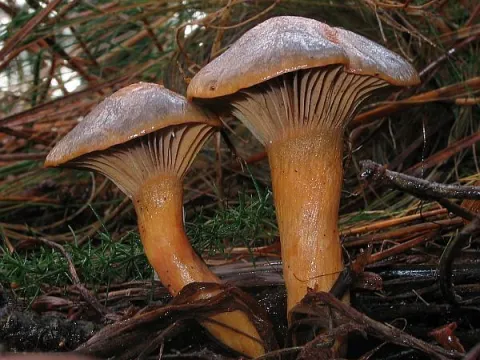
Copper spike
Chroogomphus rutilus
Copper spike (Chroogomphus rutilus) is often mistaken for a plant pathogen by those unfamiliar with forest mycology; however, it is entirely harmless to plant health.
What the section contains
Copper spike
This fungus is not a disease agent. Instead, it is an edible mushroom species that establishes a symbiotic relationship known as mycorrhiza with various conifers.
The fungus acts as a partner to trees, particularly pine, by extending the reach of their root systems to gather water and nutrients from the soil.
This mutualistic interaction is essential for the vitality of the host tree, as the fungus facilitates nutrient exchange in exchange for sugars produced via photosynthesis.
Therefore, classifying this species as a plant disease is botanically incorrect and misleading for forest management purposes.
The fruit body of the mushroom features a cap measuring 3–10 cm in diameter, typically displaying reddish-brown, copper, or purplish hues.
The gills are widely spaced and decurrent (running down the stem), turning from a light ochre color to a deep purple or near-black as the spores mature.
The flesh is firm and yellowish or pinkish, characteristically turning a vivid purple-violet shade during the cooking process.
The stem may be slightly curved and often exhibits a fibrous ring, which is a remnant of the partial veil and may be masked by fallen spores.
These mushrooms are found in coniferous and mixed woodlands, frequently growing in clusters around the base of young pine trees.
The development of Copper spike depends heavily on stable soil moisture and moderate temperatures, typically occurring from late summer to late autumn.
It favors sandy, acidic soils common in pine forests, where the accumulation of organic matter provides an ideal substrate for its mycelium.
High humidity levels following rainfall promote the emergence of fruiting bodies, which is a standard pattern for many mycorrhizal forest fungi.
The fungus thrives in ecosystems with minimal soil disturbance, as the delicate mycelial network requires time to establish and expand.
Availability of the specific host tree species is the primary factor limiting its geographic distribution and colonization success.
Copper spike causes no damage to forestry or agricultural crops. It does not infect or decay woody tissues and does not compete with plants for resources.
On the contrary, the presence of this fungus is an indicator of a healthy, productive soil environment and a thriving ecosystem.
There is no negative economic impact associated with this species; therefore, no damage assessments or mitigation strategies are required.
Misidentifying this fungus as a disease could lead to unnecessary and harmful application of fungicides, which would damage the beneficial soil microflora.
Overall, this species provides ecological benefits that contribute to the stability and nutrient cycling of the forest floor.
No control measures are necessary for Copper spike, as it does not pose a threat to plant health or economic productivity.
Management should focus on maintaining the integrity of the soil and the presence of natural tree hosts to support mycorrhizal diversity.
Avoid the use of broad-spectrum chemical pesticides, which are detrimental to the mycorrhizal fungi essential for forest regeneration.
Preventative actions in forestry should emphasize accurate identification to distinguish beneficial symbiotic fungi from actual parasitic pathogens.
Sustainable forest management practices are the best approach to ensure the survival of this and other beneficial mycorrhizal species.