
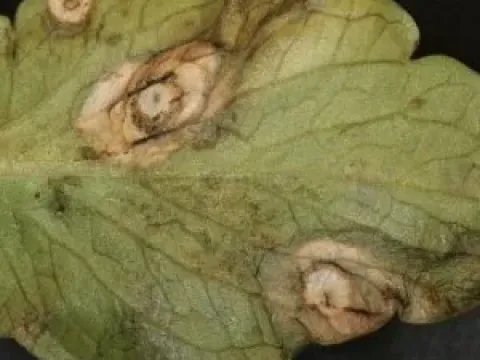
Cercosporella leaf spot of safflower
Cercosporella carthami
The causal agent of this disease is the fungus Cercosporella carthami, a mitosporic fungus that specifically targets safflower plants.
What the section contains
Cercosporella leaf spot of safflower
It persists in soil debris and crop residues as mycelium or conidia, serving as a primary source of inoculum for the upcoming growing season.
The fungus is spread primarily by wind-borne conidia and rain splashes that transport the spores to healthy leaves and stems of the host crop.
Biological development of the pathogen is closely tied to the host's physiological stages, showing peak activity during humid and warm weather conditions.
The fungus is highly specialized, and its survival strategy relies on the abundance of safflower residues left in the field after harvesting.
The disease initially manifests as small, discrete spots on the lower foliage, which expand over time into larger, necrotic lesions.
These spots often exhibit a characteristic shape with a chlorotic halo, helping to distinguish them from other common foliar diseases.
As the infection matures, the center of the lesions develops a greyish, powdery fungal growth consisting of conidia ready for further dissemination.
Progression of the infection leads to leaf yellowing, browning, and premature senescence, significantly reducing the plant's green canopy.
In severe cases, stem lesions can appear, which weaken the structural integrity of the plant and disrupt nutrient transport to the developing seeds.
High relative humidity and consistent rainfall are the most critical factors that trigger the germination and spread of Cercosporella carthami.
Dense planting patterns reduce air circulation within the canopy, creating a stagnant microclimate that fosters rapid fungal multiplication.
Monocropping or insufficient crop rotation practices allow the fungal population to build up in the soil, increasing the disease pressure significantly.
Excessive nitrogen fertilizer applications can promote lush plant growth, making tissues more succulent and easier for the fungus to penetrate.
Dew and fog conditions provide sufficient moisture for the conidia to survive and infect new leaf tissue even without direct rainfall.
The primary impact of the disease is the destruction of leaf tissue, which reduces the plant's capacity for photosynthesis and energy production.
Reduced photosynthetic efficiency leads to stunted seed filling, resulting in lower yields and significantly reduced oil content in the seeds.
Infected plants exhibit reduced vigor, making them more susceptible to drought stress and other secondary environmental challenges.
The economic loss is amplified by the potential for lodging caused by stem weakening, which complicates harvesting operations and reduces grain quality.
The infection can lead to substantial financial losses if environmental conditions favor the rapid spread of the disease during the flowering stage.
Effective management begins with robust crop rotation practices that ensure a sufficient break between susceptible safflower crops.
Thorough incorporation of crop residues into the soil via tillage is essential to hasten the decomposition of the pathogen's substrate.
Utilizing high-quality, fungicide-treated seeds serves as the first line of defense against early-season infection and inoculum introduction.
Foliar application of registered fungicides is recommended when environmental conditions are conducive to disease outbreaks and symptoms are detected.
Maintaining balanced fertilization and controlling weeds that may serve as alternative hosts are vital parts of an integrated pest management strategy.