
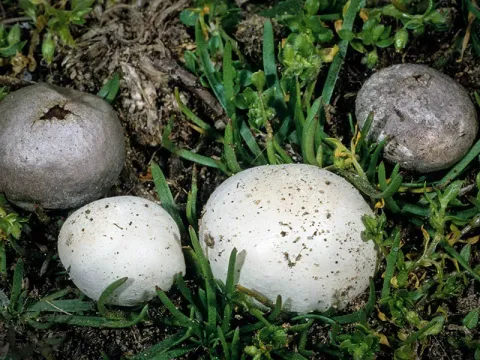
Lead-grey puffball
Bovista plumbea
The lead-grey puffball, scientifically known as Bovista plumbea, is a fungus that belongs to the Agaricaceae family. It is essential to clarify that this organism is not a plant pathogen or a cause of crop diseases.
What the section contains
Lead-grey puffball
This species is a saprotroph, meaning it derives its nutrients from decomposing organic matter in the soil, such as fallen leaves, stems, and other plant debris.
Its fruiting bodies appear as small, spherical, or pear-shaped structures that turn a smooth, distinct lead-grey color as they mature, which is the species' primary identifying feature.
The fungus produces spores within its inner cavity, known as the gleba. Once the outer layer (exoperidium) flakes off, the spores are released into the environment to colonize new substrates.
Because it lacks parasitic mechanisms, it does not attack living plants, making it a harmless and ecologically beneficial component of the natural ecosystem.
Bovista plumbea typically thrives in open grassy habitats. It is commonly found in pastures, meadows, grasslands, and forest clearings where organic material accumulates.
The fungus prefers soils with high levels of organic matter. Its mycelium spreads through the top layers of the soil, actively participating in the decomposition and nutrient cycling process.
Fruiting bodies are most abundant during periods of mild temperature and high moisture, usually occurring from mid-summer through autumn following significant rainfall.
The species grows well in both managed and wild grasslands, often appearing in groups or clusters when environmental conditions are optimal for development.
It is relatively resilient to environmental fluctuations, as its vegetative mycelium remains protected within the soil structure during dry or cold spells.
There is no evidence that the lead-grey puffball harms agricultural crops. It is not associated with any root rot, leaf spots, wilts, or other physiological plant disorders.
As a saprotrophic fungus, it does not compete with crops for resources or damage healthy plant tissues in any capacity. It does not produce toxins that could inhibit plant growth.
Farmers do not need to implement any control measures or protective strategies against this fungus, as it is completely benign to farming activities and food safety.
In fact, the presence of such fungi is often a positive indicator of healthy soil biological activity and organic matter turnover, which benefits the overall soil structure.
Using chemicals to remove Bovista plumbea is unnecessary and could potentially disrupt beneficial soil microbial communities, causing more harm than good.