
Leafy jelly fungus
Tremella foliacea
Description
Symptoms
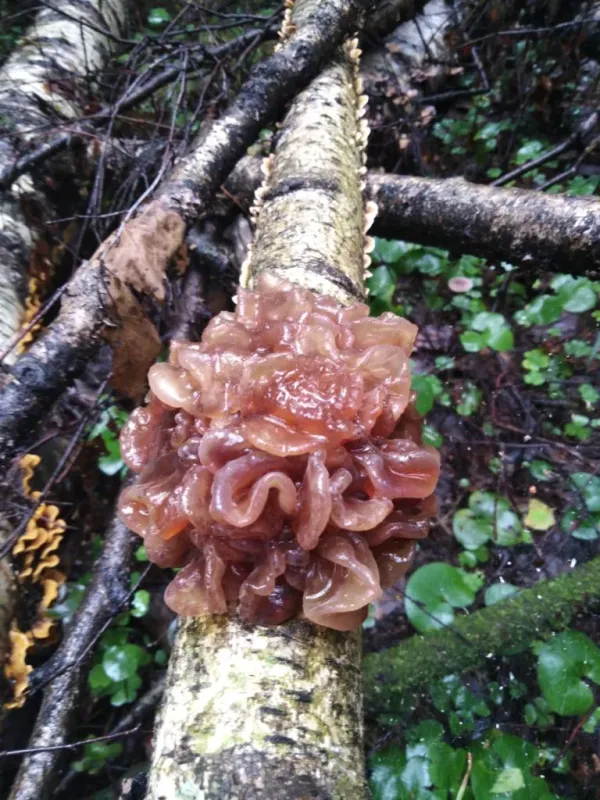
The appearance of the Leafy jelly fungus is quite unique, making it easily distinguishable from typical plant leaf spots or fungal infections. The fruiting bodies are usually foliose, folded, and brain-like.
Colors typically range from light brown to a rich, dark reddish-brown. The texture is noticeably gelatinous, soft, and flexible when moist, which is characteristic of jelly fungi.
You will find this fungus exclusively on rotting wood, dead branches, or tree stumps of deciduous trees. It acts as an indicator that the wood is already occupied by primary wood-decaying fungi.
Signs of disease such as necrosis, wilting, or lesions are completely absent on healthy plants. Since this fungus does not interact with living plant tissues, there are no symptoms to worry about in a standard garden setting.
During dry weather, the fruiting bodies tend to dehydrate, becoming dark, shriveled, and brittle. However, they remain biologically active and will swell back to their original form after the next rain.
Pathogen
The Leafy jelly fungus (scientifically known as Tremella foliacea) is a member of the jelly fungi group, belonging to the order Tremellales. It is crucial to clarify that this fungus is not an agricultural pathogen and does not cause diseases in cultivated crops.
Unlike common plant diseases, this organism does not infect living plant tissues. It does not attack crops, vegetables, or fruits, making it completely harmless to your harvest and garden productivity.
Biologically, Tremella foliacea is classified as a mycoparasite. This means it thrives by parasitizing the mycelium of other wood-decaying fungi that are already living on dead or dying wood.
Its growth cycle depends heavily on environmental conditions, particularly moisture levels. During wet seasons, it produces distinct, gelatinous, leaf-like fruiting bodies that can expand or shrink based on the presence of water.
Mycologists view this fungus as an essential component of forest ecosystems, helping in the decomposition of dead organic material rather than posing any threat to agriculture or forestry management.
Conditions for development
The primary driver for the development and spread of this fungus is high atmospheric humidity. It requires moisture to maintain its gelatinous state and to grow its fruiting bodies effectively.
The fungus thrives in moderate temperature ranges, typically between 10 and 20 degrees Celsius. It is most active during autumn months or after periods of prolonged rainfall in the summer.
The presence of a suitable substrate is mandatory. Since it is a mycoparasite, it cannot establish itself without the prior presence of other wood-decaying fungi on the decaying wood material.
Shaded areas with poor airflow and high soil moisture provide the best environment for Tremella foliacea. Open, sunny, and dry locations are rarely suitable for its growth.
In agricultural settings, the presence of untreated wood piles, neglected stumps, or decaying woody debris in damp corners creates the ideal microenvironment for this species to propagate.
Why it matters
The Leafy jelly fungus poses no threat to agricultural production. It is not a parasite of living plants and causes no economic loss to farmers or gardeners regarding crop health.
There is no evidence that this fungus negatively affects plant vigor, fruit quality, or crop yield. It is entirely unrelated to vascular diseases or rot that commonly afflict cultivated crops.
In terms of forest management, this fungus is not considered a pest. It contributes to the natural breakdown of deadwood, which is a beneficial ecological service rather than a harmful activity.
No agricultural pesticides or fungicides are necessary. Treating this organism as a disease is incorrect, and any attempt to apply chemical control is environmentally irresponsible and ineffective.
Essentially, this fungus is just a natural inhabitant of decomposing woody materials, serving as a reminder of the natural recycling processes that occur in wooded environments.
Protection
No control measures are required for the Leafy jelly fungus. Since it is not a plant pathogen, it does not need to be managed, eradicated, or monitored for agricultural purposes.
If you prefer to keep your garden free of such fungi for aesthetic reasons, simple sanitation is sufficient. Removing old stumps, fallen branches, and decaying wood from your property is the best approach.
Maintaining a clean garden by clearing away woody debris effectively removes the substrate that Tremella foliacea relies upon for its growth and reproduction.
Ensuring proper garden hygiene and managing moisture levels can also discourage the development of various wood-decaying fungi, which in turn prevents the presence of this specific jelly fungus.
If you encounter it, there is no need for alarm. Simply disposing of the decaying organic matter is enough to keep your area clear and maintain the neat appearance of your landscape.
Discussion
No discussions yet — be the first.