
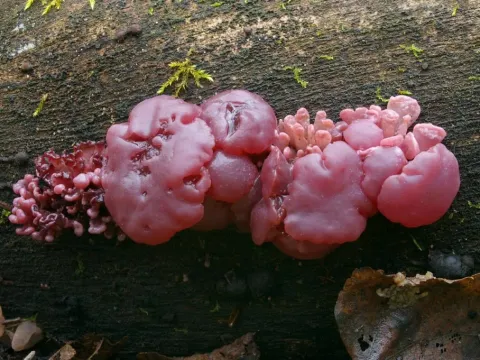
Ascocoryne sarcoides
Ascocoryne sarcoides
Ascocoryne sarcoides is an ascomycete fungus belonging to the Helotiaceae family. It is distinct for its complex life cycle, featuring both a conidial (anamorphic) stage, appearing as small pink cushions, and a teleomorphic stage, which produces larger, gelatinous, purple-pink cup-shaped structures.
What the section contains
Ascocoryne sarcoides
While primarily a saprotroph that decomposes dead wood on broad-leaved trees, it can act as a secondary pathogen in weakened or stressed specimens. It is a common component of the fungal complex involved in wood degradation.
The mycelium of the fungus penetrates deep into the wood tissue, secreting enzymes that degrade lignin and cellulose, which are essential for the structural integrity of the plant.
The fungus propagates through spores that are dispersed by wind and rain. Upon landing on fresh wounds or exposed wood surfaces, these spores germinate and begin the colonization of the host tissue.
The biology of Ascocoryne sarcoides makes it highly adaptive, allowing it to survive in varied environmental conditions until the moisture and temperature requirements for fructification are met.
The primary diagnostic sign is the presence of bright purple or pinkish gelatinous growths on the bark or wood, which can be individual or aggregated into larger, irregularly shaped masses.
Wood colonized by the fungus often shows localized discoloration, with patches appearing darker or reddish. The texture of the wood becomes spongy and loses its original density.
Bark in infected areas tends to crack, peel, and slough off, revealing the internal decay and sometimes visible fungal mycelial threads underneath.
Leaves on infested branches may show symptoms of chlorosis or premature wilting, as the fungus disrupts the transport of water and nutrients within the vascular system.
In advanced cases, affected branches become brittle and break easily under light mechanical pressure, posing a risk to the health of the entire tree canopy.
High relative humidity and frequent rainfall are the most critical factors for the active growth of Ascocoryne sarcoides. It thrives in damp, shaded environments where air circulation is restricted.
The fungus develops optimally at temperatures between +15°C and +25°C. However, it is hardy and can endure colder conditions by remaining dormant.
Open wounds on the tree, caused by improper pruning, pest activity, frost cracks, or mechanical damage, act as primary infection points for the fungal spores.
Dense, overcrowded plantations create a stagnant microclimate with high humidity, which significantly increases the risk of spore germination and colonization.
Weakened trees, suffering from nutrient deficiency or drought stress, provide less resistance to fungal colonization compared to healthy, vigorous specimens.
The major impact is the accelerated degradation of wood, which leads to structural instability, reduced aesthetic value, and eventually the death of the tree.
Infestation severely impacts the vitality and productivity of fruit-bearing trees, as resources are diverted from fruit production to defense mechanisms.
Loss of structural integrity in scaffold branches significantly increases the risk of branch failure during storms, which can lead to property damage and canopy loss.
By breaking down wood fibers, the fungus creates favorable conditions for wood-boring insects, which further accelerate the deterioration of the tree.
The spread of the fungus throughout an orchard or garden can necessitate the removal of infected trees to manage the disease and prevent further losses.
Sanitation is the most effective management strategy. All dead or infected wood should be pruned and removed from the site, followed by burning to destroy potential inoculum sources.
Disinfection of pruning tools using alcohol or bleach between cuts is mandatory to prevent the cross-contamination of healthy trees.
All pruning wounds exceeding a certain diameter must be sealed with appropriate wound dressing or antifungal pastes to prevent spore entry.
Preventative applications of copper-based fungicides can help create a protective barrier on the bark, reducing the likelihood of spore germination.
- Maintain tree vigor through proper fertilization.
- Ensure good canopy airflow through thinning cuts.
- Promptly repair mechanical damage to the tree trunk.