
Rathayibacter
Rathayibacter
Rathayibacter is a genus of Gram-positive actinobacteria that causes severe bacterial diseases in various agricultural crops. Due to its impact on grain production, it is classified as a quarantine pest in many jurisdictions worldwide.
What the section contains
Rathayibacter
These bacteria belong to the family Microbacteriaceae. Their biological cycle is unique, often requiring a nematode vector, such as Anguina species, to damage plant tissues and facilitate bacterial entry.
The pathogen survives in infected seeds, plant debris, and soil for extended periods. It demonstrates high resilience to environmental fluctuations, allowing it to persist in fields even in the absence of a host crop.
The bacterium colonizes plant tissues, causing systemic physiological disorders. It interferes with the plant's metabolic pathways, ultimately replacing normal plant tissues with its own bacterial mass and producing characteristic galls.
Dissemination primarily occurs via contaminated seed stock, agricultural machinery, and irrigation water. The association with seed-gall nematodes remains the most critical factor for the rapid spread of the disease.
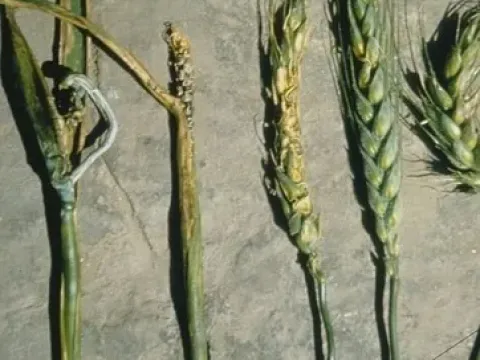
Symptoms of Rathayibacter infection include stunting, twisting of stems and leaves, and significant malformation of the inflorescence. Infected plants exhibit abnormal growth patterns compared to healthy ones.
A hallmark sign of the disease is the development of "seed galls" where grain should be. These galls consist of a dense mass of bacterial cells enclosed within the remains of the floral structures.
Leaves may show yellowing, striping, or necrotic lesions due to localized tissue destruction. In some cases, a bacterial exudate appears on the ears, which dries into a shiny, sticky film on the glumes.
Fields affected by the pathogen show patchy growth where stunted, chlorotic, and deformed plants cluster together. The overall vigor of the crop is severely compromised, and the photosynthetic efficiency drops drastically.
Microscopic analysis of the symptomatic tissue reveals high concentrations of the bacteria. The pathogen effectively displaces cellular structures and uses the plant's resources to sustain its own population growth.
The development of the disease is highly dependent on environmental conditions that favor both the bacterial pathogen and its nematode vector. Cool, moist conditions during the vegetative stage promote the survival and mobility of nematodes.
High humidity during the heading and flowering stages facilitates the movement of bacterial cells from the soil and debris to the reproductive organs of the plants.
The primary source of infection is almost always contaminated seed. When such seeds are planted, the bacteria become active as soon as the seedlings emerge, allowing for immediate colonization.
Monoculture farming practices are ideal for Rathayibacter because they allow the pathogen and its vectors to build up high populations in the soil over consecutive seasons.
Climatic factors that affect the timing of host development relative to the nematode lifecycle play a crucial role in disease severity. Any disruption in this timing can alter the impact of the bacterial outbreak.
The primary harmful effect of Rathayibacter is the massive loss of yield and grain quality. Contaminated harvests are unfit for human or animal consumption due to the presence of harmful bacterial metabolites.
Infection leads to significant economic disruption, including quarantine measures that restrict the sale and international movement of grain. This affects the profitability of farms and export capabilities.
Affected crops show reduced resilience to environmental stress, such as drought or frost, leading to further yield degradation. The weakened state of the plants makes them more vulnerable to secondary infections.
Managing this disease entails high costs for farmers, including the need for specialized seed treatments, extensive field monitoring, and strict sanitation protocols to eradicate the pathogen.
Without intervention, the pathogen can permanently establish itself in a region, threatening the long-term sustainability of local grain production and requiring constant vigilance and management.
The most important control strategy is the use of disease-free, certified seeds. Rigorous laboratory testing for Rathayibacter in seed batches is the first line of defense against the disease.
Implementing a proper crop rotation schedule is essential. Planting non-host crops for at least two to three years effectively breaks the disease cycle and reduces nematode populations in the soil.
Sanitation practices, including the deep burial of crop residues and the removal of volunteer plants, prevent the pathogen from surviving between cropping seasons. This limits the initial inoculum level.
Integrated pest management strategies focused on controlling the nematode vector are crucial in areas where the disease is established. Using resistant cultivars is a promising approach for minimizing impact.
In cases of infection, strict quarantine protocols must be followed to avoid the movement of contaminated equipment and materials. Prompt containment prevents the disease from spreading to unaffected fields.