
Description
Symptoms
The most characteristic symptom is stunted growth, where infected plants are noticeably shorter and thinner than healthy ones, leading to reduced stalk weight.
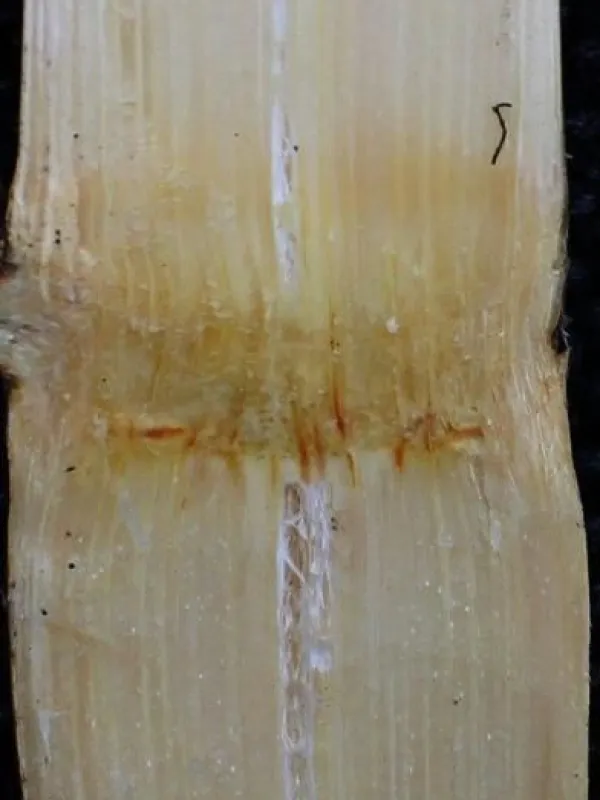
When stalks are split longitudinally, pink or reddish-brown discoloration of the internal vascular bundles is often observed, which is a key diagnostic feature.
Infected crops exhibit poor regrowth, especially in ratooning cycles, resulting in poor canopy closure and uneven stand development.
During periods of moisture stress, affected sugarcane plants show severe wilting symptoms much earlier than non-infected ones, as the blocked xylem cannot meet the plant's water demands.
Symptoms are most pronounced under environmental stress; however, in optimal growing conditions, the disease may remain asymptomatic while still reducing yields.
Pathogen
The causative agent of this disease is the bacterium Clavibacter xyli subsp. xyli, which is a gram-positive, non-spore-forming, fastidious bacterium.
The pathogen is strictly localized in the xylem vessels of sugarcane, where it multiplies and obstructs the movement of water and nutrients.
It is transmitted primarily through contaminated mechanical equipment used for planting and harvesting, making human activity the main vector of spread.
The bacterium has a high survival rate within infected stalks, ensuring its transmission to future ratoon crops via stubble or vegetative propagation material.
Being a systemic pathogen, it infects the entire plant, and despite its severity, the disease often lacks distinct external symptoms, making it an "invisible" threat.
Conditions for development
The prevalence of the disease is directly correlated with the number of ratoon crops grown; the longer a plantation is left, the higher the inoculum levels become.
Mechanized harvesting is the primary condition for spread, as machinery contaminated with bacteria transfers the pathogen from infected to healthy plants across the field.
The use of infected seed cane is the most significant factor in introducing the pathogen into new, clean areas or previously uninfected fields.
Warm and humid conditions favor bacterial proliferation within the host's vascular system, exacerbating the impact of the infection.
Lack of sanitation practices during the mechanical cutting of seed cane facilitates the widespread dissemination of the bacteria within the nursery plots.
Why it matters
The disease causes significant economic losses by drastically reducing total biomass and the overall yield of cane per hectare.
Sugar content (sucrose levels) is adversely affected in infected stalks, leading to lower juice quality and increased processing challenges in sugar mills.
Stands become gappy and weak, forcing farmers to replant their fields more frequently, which significantly increases cultivation costs.
The disease limits the potential of high-yielding varieties, often masking their genetic performance and rendering crop improvements ineffective.
The cumulative effect of ratoon stunting disease results in a continuous decline in production efficiency across consecutive cropping cycles.
Protection
The use of certified disease-free planting material, produced through hot water treatment or heat-treated tissue culture, is the most effective control strategy.
Rigorous sanitation of all harvesting and planting equipment, including disinfection with approved chemical agents, is essential to halt the spread of the pathogen.
Breeding and selecting resistant or tolerant sugarcane varieties provide a long-term, sustainable solution for managing the disease in commercial fields.
Limiting the number of ratoon cycles before replanting can help maintain yield levels and reduce the accumulation of the bacterial inoculum.
Strict quarantine measures and monitoring of seed cane movement between regions are crucial for preventing the introduction of this pathogen into clean sugarcane-producing areas.
Pathogens and affected parts
Affects crops · 1
Discussion
No discussions yet — be the first.