
Bacterial wilt of solanaceous crops
Ralstonia pseudosolanacearum
The causative agent of this disease is the Gram-negative, motile bacterium Ralstonia pseudosolanacearum. It is a highly destructive soil-borne pathogen that infects the vascular system of various plants.
What the section contains
Bacterial wilt of solanaceous crops
This pathogen has a wide host range and can survive in the soil, in plant debris, and in irrigation water. It is recognized as a major quarantine pest globally due to its potential for causing massive losses.
Once inside the plant, the bacteria colonize the xylem, where they multiply rapidly. They produce massive quantities of extracellular polysaccharides (EPS) that clog the vascular conduits.
This biological mechanism physically prevents the movement of water and dissolved nutrients to the foliage, which leads to the characteristic wilting symptoms observed in infected hosts.
The bacterium is highly adaptable to different environmental conditions and can persist in the environment for several years, making eradication extremely difficult once it is established.
The first symptom is usually the wilting of the youngest leaves during the hottest part of the day, followed by recovery at night. As the infection progresses, the wilt becomes permanent.
The foliage remains green initially, but eventually becomes chlorotic and then necrotic. Plants may collapse and die very rapidly, often appearing healthy until shortly before the collapse.
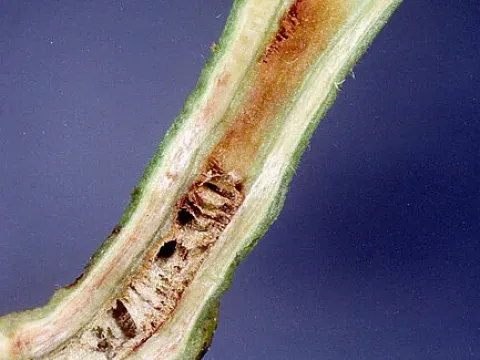
When the stem is cut crosswise, a visible browning of the vascular tissue is observed. If the cut end is suspended in clear water, a milky bacterial stream (ooze) may be seen flowing out.
Roots of infected plants often show signs of decay or browning. In some cases, adventitious roots may sprout along the main stem as the plant attempts to compensate for the damaged root system.
Fruit development is often severely hampered. Fruits might shrivel or drop prematurely, and the overall plant growth is stunted significantly once the vascular system is compromised.
The development of Ralstonia pseudosolanacearum is strongly favored by high soil and air temperatures, typically ranging from 25°C to 35°C, making it a serious threat in warm climates.
High soil moisture is another critical factor. The pathogen thrives in waterlogged or overly saturated soil conditions, which significantly facilitates the spread of the bacteria.
Irrigation practices play a major role in dissemination. The bacteria can easily spread from infected plants to healthy ones via irrigation water, especially in open fields or greenhouse systems.
Injuries to the root system, caused by soil cultivation, insect feeding, or nematodes, act as primary entry points for the bacteria to invade the plant tissue.
In greenhouses, the lack of crop rotation and the reuse of contaminated substrate allow the pathogen to reach high population densities, leading to devastating outbreaks.
Bacterial wilt is considered one of the most destructive diseases for tomatoes, potatoes, peppers, and eggplants, capable of causing total crop failure within a very short time.
The persistence of the pathogen in soil renders land unsuitable for growing susceptible solanaceous crops for several years, which forces farmers to abandon or rotate to non-host crops.
There are no reliable, broad-spectrum chemical treatments to cure infected plants. Therefore, the disease management relies entirely on prevention, sanitation, and the use of resistant varieties.
The pathogen can be easily spread through contaminated equipment, tools, and even human footwear, allowing the infection to move rapidly across different sections of a farm.
Economic losses are severe, involving not only the immediate loss of the season's yield but also the high costs associated with land decontamination and potential quarantine measures.
The primary control strategy involves the use of certified, disease-free planting material. Choosing resistant or tolerant cultivars is the most effective approach for management.
Implementing a strict crop rotation program (using non-host crops for 3-4 years) is essential to reduce the bacterial population in the soil naturally.
Sanitation practices, such as disinfecting tools and machinery between different areas of the field, are vital to prevent the spread of the pathogen from infected sites.
- Avoid over-irrigation to maintain optimal soil moisture;
- Remove and destroy infected plants with their entire root ball immediately;
- Control soil-borne pests like nematodes that facilitate root entry;
- Improve soil drainage to prevent saturated conditions;
- Regularly monitor fields for early wilting symptoms.
Integrated pest management (IPM) should be prioritized, focusing on soil amendments and biological control agents that can help suppress the pathogen population in the rhizosphere.