
Bacterial wilt of pepper
Pseudomonas capsici
The initial symptom of bacterial wilt is the sudden wilting of leaves during the hottest part of the day. Unlike other wilts, affected plants may appear to recover at night when temperatures drop.
What the section contains
Bacterial wilt of pepper
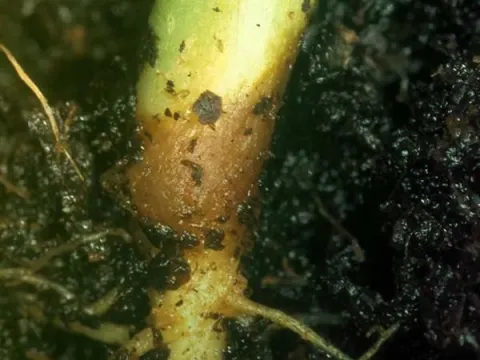
A cross-section of the stem reveals characteristic browning and tissue decay in the vascular bundles. The pith may become hollow, water-soaked, or yellowish as the disease progresses.
The root system often shows signs of decay, appearing darker and weaker than healthy roots. In advanced stages, the plant collapses completely, even if the foliage remains green.
A reliable diagnostic field test involves placing a segment of an infected stem into a clear container of water. A milky white bacterial ooze should emerge from the stem within minutes.
As the infection advances, the plant tissue loses its internal structure, causing the entire plant to dry up rapidly while remaining upright, distinct from the drooping caused by water stress.
The causative agent of bacterial wilt in peppers is the bacterium Pseudomonas capsici. It is a highly aggressive pathogen that attacks the host's vascular system, causing systemic infection.
The pathogen primarily colonizes the xylem, where it multiplies rapidly. The accumulation of bacterial mass and extracellular polysaccharides physically blocks the flow of water and nutrients.
This bacterium is a soil-borne pathogen capable of surviving in the soil, on plant debris, and in the root zones of various weeds for several years, ensuring long-term persistence.
Transmission of Pseudomonas capsici is highly efficient through contaminated water, soil movement, infected tools, and even transplanting processes if sanitation is not maintained.
Once inside the plant, the bacteria move through the vascular system, spreading from the roots to the stems and leaves, eventually destroying the structural integrity of the entire plant.
Bacterial wilt thrives under high temperatures (typically 25°C to 30°C) and high soil moisture levels. Warm and humid conditions are the most critical factors for rapid disease development.
Soil structure plays a key role; poorly drained, heavy soils that retain moisture provide a stable environment for the bacteria to migrate between plants through the soil solution.
Mechanical injuries, such as those caused by pruning, weeding, or root disturbance during transplanting, serve as entry points for the pathogen to enter the plant tissues.
The disease is more prevalent in fields with a history of intensive cultivation of solanaceous crops, where the pathogen load has accumulated over multiple planting cycles.
Over-irrigation, especially during hot periods, can worsen the situation by facilitating the spread of bacteria through the soil water, leading to localized outbreaks becoming epidemic.
Bacterial wilt is considered one of the most destructive diseases for pepper cultivation. Once a plant is infected, it cannot be cured, leading to a total loss of the individual plant.
Large-scale outbreaks can decimate entire pepper fields, resulting in severe economic hardship. In favorable conditions for the bacteria, crop loss can reach as high as 80-90%.
The persistence of the pathogen in the soil creates a long-term problem for growers, as the infected fields become unsuitable for other susceptible crops like tomatoes and potatoes.
The rapid spread of the disease often leaves little time for intervention, making prevention the only viable strategy for managing the risk of bacterial wilt in commercial and private gardens.
The infection also complicates nursery management, as contaminated equipment or infected seedlings can spread the bacteria to new, previously disease-free fields.
The first line of defense is the use of certified, pathogen-free seeds and seedlings. Resistant or tolerant hybrids should be selected when available for specific regions.
Implementing a strict crop rotation cycle of at least 3-4 years, avoiding other solanaceous crops in the same area, is essential to starve the pathogen in the soil.
- Sanitizing gardening tools with disinfectant solutions between uses.
- Removing and destroying infected plants along with the surrounding soil.
- Ensuring proper field drainage to avoid water stagnation.
- Controlling soil-borne insects that can damage roots and create entry points.
Biological control agents, such as beneficial soil bacteria like Bacillus subtilis, may help suppress the growth of Pseudomonas capsici when applied preventively in the nursery or at transplanting.
Avoid excessive nitrogen application, as it promotes lush, succulent growth that is more susceptible to infection. Maintaining optimal balance in nutrition strengthens the plant's natural resistance.