
Bacterial wilt of cucurbits
Erwinia tracheiphila
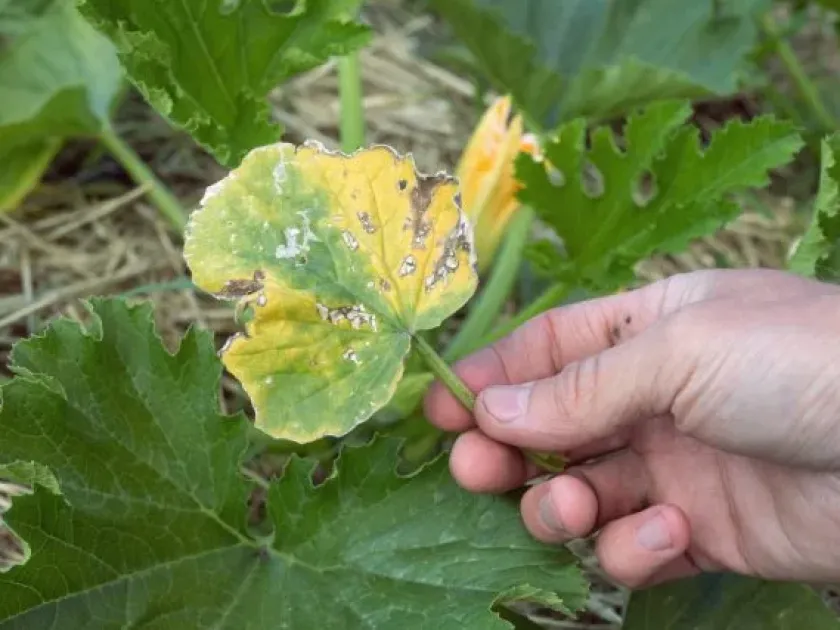
Description
Symptoms
The first symptom is the sudden flagging or wilting of individual leaves, which may occur on a single vine or leaf lobe.
Initially, affected leaves lose turgor and droop, but often retain a green color during the early stages of the disease.
As the infection progresses, wilting becomes permanent, leading to yellowing, necrosis, and the eventual death of the entire plant.
A reliable diagnostic sign is the presence of sticky, stringy bacterial ooze found within the vascular bundles of the stems.
To confirm, cut a main stem near the base, touch the cut surfaces together, and slowly pull them apart to see if thin white mucous strands appear.
Pathogen
The causative agent of the disease is the bacterium Erwinia tracheiphila, which specifically colonizes the vascular system of cucurbitaceous crops.
The pathogen propagates rapidly within the xylem vessels, producing a viscous extracellular polysaccharide matrix that physically obstructs water flow.
The primary vectors responsible for transmission are striped and spotted cucumber beetles (Acalymma vittatum and Diabrotica undecimpunctata).
The bacteria overwinter within the digestive tracts of these beetles, which serve as the primary reservoir for infection in the spring.
Plants become infected when beetles feed on the leaves or stems, introducing the bacteria into the xylem through fresh feeding wounds.
Conditions for development
Disease development is highly dependent on the presence and activity of the beetle vectors during the growing season.
Warm and moderately humid weather conditions promote both beetle activity and the rapid multiplication of Erwinia tracheiphila within the host.
High beetle populations in the field correlate directly with an increased incidence of the disease among susceptible crops.
Plant wounds caused by other factors, such as mechanical cultivation or wind damage, can also serve as entry points for the bacteria if beetles are present.
Environmental conditions that favor the rapid colonization of the crop by cucumber beetles are the primary drivers of localized outbreaks.
Why it matters
Bacterial wilt is one of the most destructive diseases for cucumbers, muskmelons, and pumpkins, frequently resulting in total crop loss.
The disease can cause the death of plants at any stage of development, often killing them before fruits can be harvested.
The speed at which the wilt spreads through a planting makes it extremely difficult to contain once the first symptoms appear.
Economic damage is severe, as there is no effective treatment for infected plants, necessitating their immediate removal and destruction.
The necessity for continuous insecticide applications throughout the season increases production costs significantly for commercial growers.
Protection
The most effective strategy for managing bacterial wilt is the rigorous control of cucumber beetle populations throughout the plant's life cycle.
Application of systemic or contact insecticides should begin immediately upon plant emergence to prevent beetles from feeding and transmitting the pathogen.
Row covers are an excellent physical barrier that can be used on young plants to prevent initial colonization by beetle vectors.
Prompt rogueing and removal of wilted plants from the field helps to reduce the availability of the pathogen for further insect transmission.
- Utilizing crop rotation to break the life cycle of the beetles and reduce local populations.
- Maintaining field edges free of weeds that might attract or harbor the insect vectors.
- Choosing varieties that exhibit lower susceptibility or high tolerance to beetle feeding where available.
Discussion
No discussions yet — be the first.