
Pantoea ananatis
Pantoea ananatis
Pantoea ananatis is a facultative anaerobic, Gram-negative bacterium classified within the Erwiniaceae family. Originally identified in pineapple, it has emerged as a significant global pathogen affecting a wide range of economically important crops, including maize, onions, and various horticultural species.
What the section contains
Pantoea ananatis
This pathogen is highly versatile, capable of colonizing various niches, including plant tissues, the soil environment, and agricultural residue. Its ability to survive on seeds is particularly problematic for international agriculture and trade.
The transmission of the disease is multifaceted, involving both direct and indirect routes. Seeds act as a primary carrier, while insects such as thrips play a crucial role as vectors, introducing the bacteria directly into the plant vascular system during feeding.
The virulence mechanism of Pantoea ananatis involves the secretion of various enzymes and phytotoxins that degrade plant cell walls. This enzymatic activity facilitates rapid colonization and systemic movement of the bacteria through the xylem and phloem.
Genetic diversity within the species is substantial, leading to varying degrees of pathogenicity across different strains. This complexity complicates the development of universal diagnostic tools and resistant crop varieties.
The symptoms induced by Pantoea ananatis are diverse, often resembling those of other bacterial infections, which can lead to misdiagnosis. Common manifestations include water-soaked lesions that quickly become necrotic.
In maize, the pathogen often causes the development of elongated, light-colored stripes or spots on the leaves. As the disease progresses, these lesions can coalesce, resulting in significant tissue necrosis and a reduction in the plant's overall photosynthetic capacity.
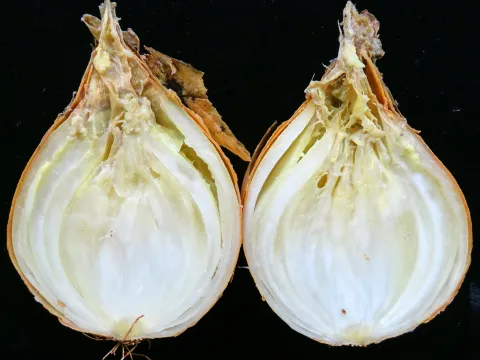
Onions and other bulb crops exhibit center rot symptoms, characterized by the softening of internal scales. The infected bulbs frequently emit a foul, putrid odor due to the activity of soft-rot bacteria that often colonize the area alongside Pantoea ananatis.
Stem infections are another frequent sign, particularly in stressed plants. These areas often appear as sunken, dark lesions that may exude a bacterial ooze during periods of high humidity, drying into a thin, shiny crust.
- Water-soaked lesions on leaves.
- Elongated chlorotic or necrotic stripes.
- Soft rot of bulb and stem tissues.
- Systemic wilting and stunting.
- Production of bacterial exudates on foliage.
Warm and humid environments are the most favorable for the proliferation of Pantoea ananatis. Temperatures ranging from 25°C to 30°C significantly accelerate the metabolic rate and replication of the bacterial population.
Precipitation and excessive humidity are critical drivers of disease outbreaks. Raindrops facilitate the splash dispersal of bacteria, while leaf wetness allows for easier entry through natural openings like stomata.
Mechanical stress caused by wind, hail, or agricultural machinery creates entry points for the pathogen. In regions prone to severe storms, the incidence of Pantoea ananatis is often significantly higher due to the increased frequency of leaf damage.
The presence of insect vectors is a major environmental factor. Insects that damage the epidermis of the plant facilitate the entry of the pathogen, turning a minor infection into a systemic disease event.
Poor soil drainage and high-density planting can create microclimates with restricted airflow, trapping humidity and providing the necessary environment for the bacteria to thrive and spread throughout the field.
The primary economic harm caused by Pantoea ananatis is the reduction of crop yield and quality. In severe cases, the necrosis of photosynthetic tissues leads to significant stunted growth and poor grain filling in cereal crops.
For horticultural products like onions and lettuce, the bacterial rot renders the produce unmarketable. Even low levels of infection can cause rapid spoilage during transport and storage, leading to substantial post-harvest financial losses.
The disease affects seed viability, leading to poor germination rates and uneven field stands. This forces growers to invest more in re-seeding or to settle for lower plant populations, which directly impacts final output.
Furthermore, the systemic nature of the infection means that the plant's overall health is compromised, making it more susceptible to opportunistic secondary infections by other fungi and bacteria.
Global trade restrictions may also be imposed on regions where Pantoea ananatis is prevalent, as it is classified as a quarantine pest in several countries, creating barriers to the export of agricultural commodities.
Integrated pest management (IPM) is the most effective approach for controlling Pantoea ananatis. The first line of defense is the use of disease-free, certified seeds, which minimizes the risk of introducing the pathogen to a clean field.
Crop rotation practices should be strictly observed. Moving away from susceptible hosts for at least 3 years can significantly decrease the inoculum density within the soil and on residual plant material.
Targeted insect control, especially focusing on thrips and other piercing-sucking insects, is essential to minimize the vector-mediated spread of the bacteria during the growing season.
Proper sanitation practices, including the deep incorporation of crop debris into the soil immediately after harvest, help in accelerating the decomposition process and reducing the survival time of the pathogen.
While chemical control using copper-based bactericides can provide a prophylactic effect, it is generally limited in its ability to eradicate established infections. Research into resistant plant cultivars remains the most promising long-term solution.