
Panama disease
Musicola paradisiaca
Description
Symptoms
Early symptoms of the disease often appear on older leaves, which begin to yellow along the leaf margins, progressively moving toward the midrib.
Over time, affected leaves droop and dry out, forming a characteristic "skirt" of dead foliage around the pseudostem. The plant growth halts, leading to eventual death.
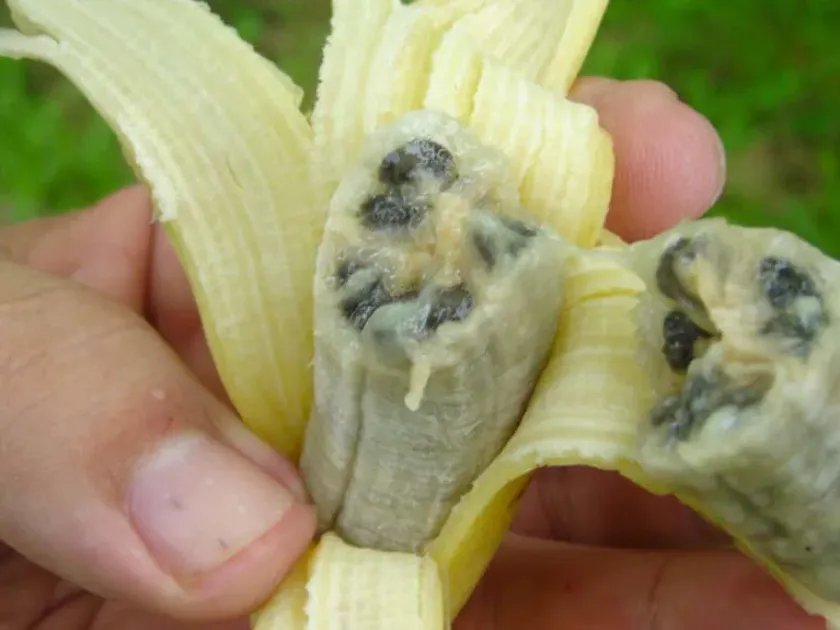
When the pseudostem or rhizome is cut, a distinct brownish or blackish discoloration of the vascular bundles becomes visible. This is a primary diagnostic marker for Fusarium wilt.
In advanced cases, the center of the stem may decay entirely, and the general state of the plantation becomes stunted and uneven.
It is important to note that external wilting signs often appear at later stages, after the fungus has deeply colonized the root system and vascular pathways.
Pathogen
Panama disease, also known as Fusarium wilt, is caused by the soil-borne fungus Fusarium oxysporum f. sp. cubense. This specialized pathogen infects the vascular system of the plant, blocking the transport of water and essential nutrients.
The fungus can survive in the soil as chlamydospores for decades, making control extremely difficult even in the absence of a host plant. Several races of the pathogen exist, with Tropical Race 4 (TR4) being the most destructive to current global banana production.
The infection enters the plant through the root system, often via microscopic wounds caused by nematodes or mechanical soil disturbance. Once inside, the mycelium spreads through the xylem vessels up into the stem.
As it grows, the fungus produces specific toxins that cause rapid necrosis of vascular tissues. This leads to severe wilting, even in plants that appear healthy on the outside.
The pathogen can travel over long distances via infected planting material, contaminated agricultural machinery, or soil particles attached to footwear or tools.
Conditions for development
High soil temperatures and increased moisture levels promote disease development by creating an ideal environment for spore germination and fungal activity.
Acidic soils with nutrient deficiencies often favor the pathogen's growth, as they weaken the natural defense mechanisms of the banana plant.
Poor drainage and waterlogged soil conditions induce plant stress, making crops more susceptible to infection through root hairs.
Intensive monoculture farming on large scales facilitates the explosive spread of the fungus, as the pathogen moves efficiently from one plant to another.
Violation of quarantine regulations during the transport of seedlings remains the main factor contributing to the emergence of new outbreaks in previously unaffected regions.
Why it matters
Panama disease is arguably the most serious banana disease globally, capable of destroying commercial plantations and threatening food security for millions.
Economic losses arise from the total destruction of harvests in infected areas and the high cost of land remediation, which is often not feasible for soil-borne pathogens.
Due to the high persistence of fungal spores, infected sites cannot be used for susceptible banana varieties for many years following an outbreak.
The scale of damage is historical; the disease wiped out the once-popular "Gros Michel" variety in the mid-20th century, forcing the industry to shift to the "Cavendish" variety.
The spread of Tropical Race 4 (TR4) today threatens the "Cavendish" variety, which was previously considered relatively resistant to the pathogen.
Protection
The only truly reliable method of control currently is the use of resistant banana varieties, with extensive breeding programs underway globally.
Strict phytosanitary controls during the import of planting material are crucial to prevent the introduction of spores into new geographical zones.
When an outbreak is detected, the standard practice involves isolation and the complete destruction of diseased plants, including the entire root system, alongside tool disinfection.
Fungicide application is currently ineffective for curing already infected plants, so efforts are focused on preventative soil treatments and strict biosecurity protocols.
Implementing proper crop rotation and improving soil structure help reduce the initial inoculum level but do not guarantee complete eradication in infected regions.
Discussion
No discussions yet — be the first.