
Fire blight
Erwinia pyri
Fire blight is caused by the bacterium Erwinia amylovora, a highly contagious pathogen affecting the Rosaceae family.
What the section contains
Fire blight
The bacterium is a gram-negative rod that colonizes the plant's vascular tissue, leading to rapid necrosis of shoots, blossoms, and fruits.
It overwinters in the margins of infected bark, remaining dormant until the physiological activity of the tree resumes in spring.
The pathogen utilizes the xylem for movement, creating systemic infections that can kill entire branches or the entire tree.
Bacterial exudate, appearing as sticky droplets on the surface of infected parts, is the primary source of initial spring infections.
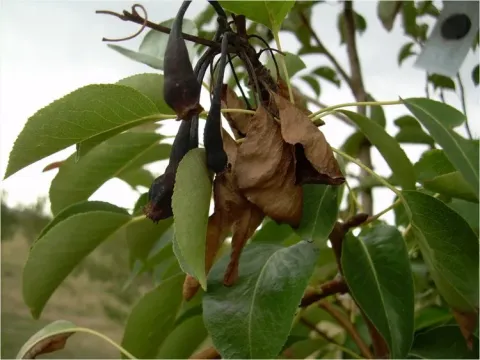
The hallmark symptom is the sudden wilting and blackening of blossoms, which then shrivel and remain attached to the tree.
New shoots exhibit a characteristic curling at the tips, resembling a shepherd's crook, and turn black or dark brown.
Leaves on infected branches die but do not fall, giving the canopy a scorched, fire-damaged appearance.
Cankers often form on branches or the trunk, which may crack or ooze a translucent, sticky bacterial liquid.
Internal bark tissues beneath the epidermis show reddish-brown discoloration when cut, distinguishing the disease from other fungal wilts.
Warm and humid weather conditions are ideal for the rapid multiplication and spread of the bacterium.
Temperatures ranging from 18°C to 25°C during the bloom period create the perfect environment for infection to thrive.
Rain splash and high winds are major environmental factors that distribute the bacteria to healthy blossoms and foliage.
Insects, particularly pollinators, act as active vectors, moving the pathogen from infected blossoms to healthy ones.
Heavy nitrogen fertilization promotes succulent vegetative growth, which is significantly more susceptible to bacterial penetration.
Fire blight is considered one of the most destructive diseases in commercial pomology, capable of decimating orchards in one season.
The disease leads to severe economic losses due to the need for total removal and burning of severely infected trees.
Infections on the main scaffold branches or the trunk are fatal, as they eventually girdle the tree, cutting off nutrient circulation.
Its status as a regulated quarantine pathogen imposes trade restrictions on nurseries and fruit growers in many countries.
The unpredictable nature of its spread makes it difficult to manage without rigorous surveillance and preventive action.
Management centers on strict sanitation and the prompt removal of infected materials during the dormant and growing seasons.
Pruning cuts must be made at least 20–30 cm below the visible symptoms into healthy wood to ensure total clearance of the bacteria.
Sanitizing all pruning tools between each cut with 70% alcohol or a 10% bleach solution is mandatory to prevent cross-contamination.
- Planting resistant or less susceptible cultivars.
- Applying copper-based bactericides during the green tip stage.
- Managing insect populations like aphids and psyllids.
- Implementing regular orchard scouting for early symptom detection.
Integrated management is essential, as there is currently no cure for trees that have already developed systemic trunk infections.