
Description
Symptoms
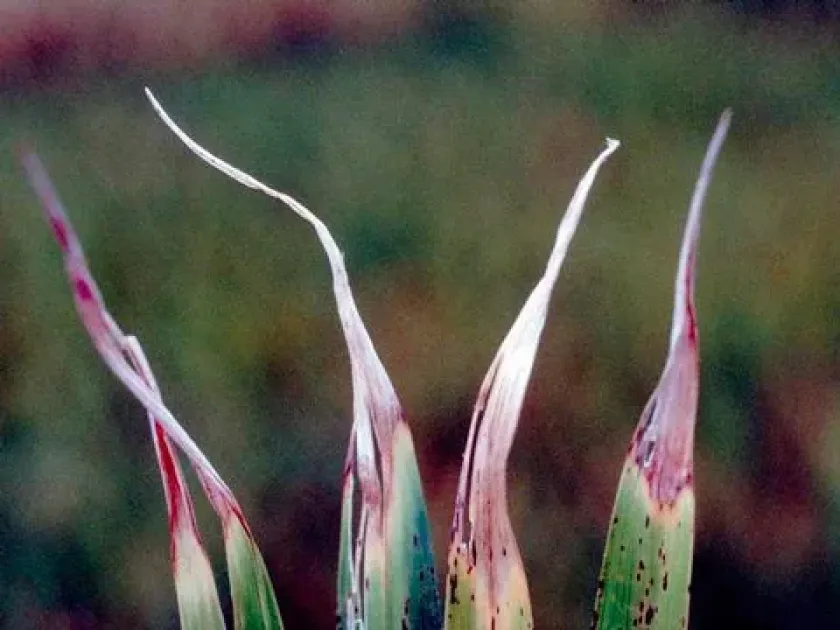
The hallmark symptom of this disease is the characteristic whitening or bleaching of the leaf tips. In early stages, the affected tissue loses chlorophyll, turning yellowish and eventually becoming straw-colored or white.
As the disease progresses, the whitening can extend several centimeters down the leaf blade. Leaves frequently become twisted, distorted, or shredded, which significantly impairs the plant's ability to photosynthesize effectively.
Infected plants display a distinct reduction in height and vigor. Tillering is often abnormal, and lower leaves may die prematurely, leading to a general loss of biomass and stunted growth throughout the field.
The reproductive development is severely impacted; panicles become short and malformed. Grains within these panicles are often stunted, deformed, or entirely sterile, leading to substantial yield losses.
Visual symptoms may remain latent for some time after planting or germination. Due to this delayed appearance, the disease is sometimes misidentified as nutrient deficiency, making expert diagnosis essential.
Pathogen
The causative agent of the disease is the rice leaf nematode, Aphelenchoides besseyi. It is a microscopic, ectoparasitic nematode that resides primarily within the leaf sheaths and near the plant's growing point.
This organism is highly resilient to environmental stressors. It can enter a dormant state known as anhydrobiosis, allowing it to survive for several years in dry seeds until moisture becomes available again.
The nematode's life cycle is synchronized with the phenology of the rice plant. Upon germination or transplanting, the nematodes migrate towards the plant's apical meristem to feed and reproduce rapidly.
Beyond rice, A. besseyi acts as a pathogen for other crops, most notably strawberries, where it causes a condition known as "summer dwarf" or leaf crinkle. It can also persist on various weed grasses.
Dissemination occurs through infested seeds and contaminated irrigation water. Because the nematode hides within plant tissues, it is notoriously difficult to eradicate once an infestation is established.
Conditions for development
High humidity and rainfall are the primary environmental drivers for the disease. Nematodes require a thin film of water on the plant surface to move and successfully infect new leaf tissues.
Optimal temperatures for nematode activity range from 25°C to 30°C. In these warm, humid conditions, the generation time is minimized, allowing for rapid build-up of the nematode population in the field.
Irrigation systems are a major vector for the spread of A. besseyi. Water flowing between rice paddies easily transports the nematodes from infested plants to healthy ones, facilitating rapid disease spread.
Poor crop rotation practices and the reuse of infested seeds are the main causes for introducing the nematode to new areas. Stubble left in the field after harvest can also serve as a reservoir for the pest.
The disease is most prevalent in tropical and subtropical rice-growing regions. However, it can reach epidemic proportions in temperate regions during summers characterized by unusually high rainfall and temperatures.
Why it matters
The economic impact of A. besseyi is significant, with yield losses ranging from 10% to 50%. The reduction is caused by reduced grain set, empty husks, and stunted plant development.
Grain quality is severely compromised. Harvested rice is often shriveled and lightweight, which reduces its milling yield and overall market value, making it unacceptable for premium export standards.
Infested plants show reduced tolerance to other biotic stresses. The damage caused by nematodes often facilitates secondary infections by various fungi and bacteria, leading to panicle rots and grain discoloration.
The uneven maturity of the crop in infested fields complicates harvesting operations. Harvesting efficiency is further reduced because light, empty grains are easily blown away by the combine's air stream.
Furthermore, the presence of the nematode imposes additional costs related to seed certification, mandatory quarantine treatments, and the loss of potential income due to lower-quality produce.
Protection
The most effective strategy is the use of nematode-free, certified seeds. Hot water seed treatment (soaking seeds at 50–55°C for 10–15 minutes) is a standard and effective method for eliminating nematodes from planting stock.
Strict adherence to quarantine and phytosanitary regulations is crucial to prevent the introduction of A. besseyi into uninfested areas. Screening seed batches for the presence of the nematode is essential.
Integrated farm management should include thorough destruction of crop residues after harvest, deep plowing to bury infested plant debris, and the management of alternative weed hosts around the paddy.
Breeding and deploying resistant rice cultivars is the most sustainable long-term solution. Genetic resistance helps suppress nematode reproduction even in favorable environmental conditions.
Chemical control during the growing season is rarely effective due to the nematode's protected position within plant tissues. Nematicides are generally reserved for severe outbreaks and must be used with strict adherence to safety guidelines.
Pathogens and affected parts
Affects crops · 1
Discussion
No discussions yet — be the first.