
Sclerotinia rot of onion
Sclerotinia allii
Description
Symptoms
The initial symptoms include yellowing and progressive dieback of the leaf tips, which slowly extends down the foliage. Plants lose turgidity and eventually collapse.
A dense, white, cotton-like mycelial mat develops at the base of the plant and around the root zone. This fungal growth is a key diagnostic feature of Sclerotinia infection.
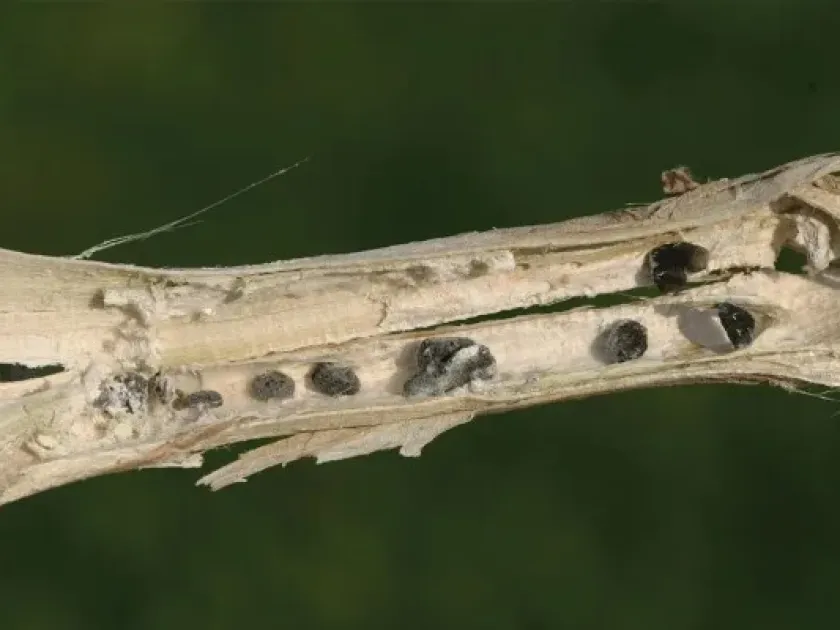
As the infection progresses, sclerotia form within the infected plant tissue. Initially, these appear as white structures that eventually turn black, hard, and irregular in shape.
Infected bulb tissues become soft, water-soaked, and may emit a foul odor as secondary bacterial rot often follows the initial fungal infection.
Infected plants can be easily pulled from the ground because the entire root system is usually compromised or entirely destroyed by the fungal mycelium.
Pathogen
The disease is caused by the fungus Sclerotinia allii (often associated with the broader Sclerotinia complex). This pathogen is highly resilient due to its ability to produce sclerotia, which are hard, black, resting structures that survive in the soil for many years.
The fungal life cycle involves the formation of apothecia that release ascospores, which are then disseminated by wind and water splash. Furthermore, the infection can spread through mycelial growth directly from the soil into the onion roots.
The fungus secretes specialized enzymes that break down plant cell walls, leading to rapid tissue decay. This enzymatic activity is what gives the infected onion tissues their characteristic soft and mushy appearance.
It attacks a wide range of Allium species, including bulb onions, garlic, leeks, and bunching onions. The disease is problematic both in the field during the growing season and in storage facilities post-harvest.
The fungus spreads between plants by mycelial growth along roots, leading to circular patterns of infection in the field, often called "pockets" of rot.
Conditions for development
Cool and wet environmental conditions are ideal for the development of Sclerotinia rot. The fungus thrives at temperatures ranging from 12°C to 18°C (54°F to 64°F).
Excessive soil moisture, particularly during the early growth stages, provides the necessary environment for spores to germinate and for mycelium to colonize the host.
Poor soil drainage and high-density planting exacerbate the problem by keeping the microclimate around the root zone humid for prolonged periods.
Acidic soil conditions favor the activity of the pathogen, whereas neutral or slightly alkaline soils tend to be less conducive to its growth.
Continuous cropping of Allium species on the same ground leads to a high concentration of sclerotia in the soil, significantly increasing the inoculum pressure.
Why it matters
The primary impact is significant stand loss due to plant death, resulting in reduced yields and a loss of investment in seeds and labor.
It causes devastating losses during storage. A few infected bulbs can cause "nesting" rot, where the infection spreads to healthy surrounding bulbs, resulting in total loss of stored produce.
Infected bulbs are often unsuitable for market due to poor visual quality, softness, and reduced shelf life, causing substantial economic distress to growers.
The presence of the disease necessitates expensive control measures and limits the crop rotation options for the affected land for several years.
Seed-bearing onions can also be infected, resulting in lower quality seed lots that may carry fungal inoculum to new fields.
Protection
Long crop rotation (4–6 years) with non-host crops is the most effective way to reduce the population of sclerotia in the soil to manageable levels.
Adjusting soil pH through liming to reach a neutral range can help suppress the activity of the fungus and strengthen the crop’s natural defenses.
The use of certified disease-free sets and rigorous inspection of bulbs before planting are essential steps in preventing the introduction of the pathogen to clean fields.
- Improve soil drainage by using raised beds or subsoiling to prevent water stagnation.
- Sanitation: Remove and burn all infected plant material after harvest to reduce inoculum carryover.
- Applying fungicides during the growing season when environmental conditions favor disease outbreaks.
Deep plowing can bury infected crop debris and sclerotia deeper into the soil profile, which facilitates their degradation and prevents them from reaching the root zone of the next crop.
Discussion
No discussions yet — be the first.