
Witches broom of broom
Sarothamnus witches
Description
Symptoms
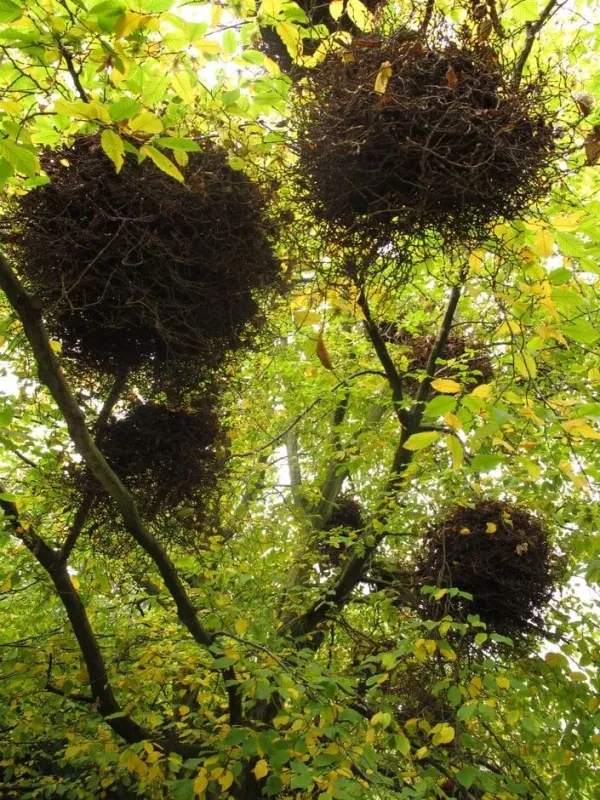
The primary symptom of the disease is the abnormal clustering of shoots, which visually resembles a dense broom. On affected branches of the broom shrub, a multitude of shortened, thin, and weak shoots develop, all originating from a single point.
Leaves on the deformed branches often become smaller, chlorotic, and take on a yellowish hue. In some cases, there is a distinct change in the shape of the leaf blades and premature leaf drop during the middle of the growing season.
The plant completely ceases to bloom or forms underdeveloped, deformed buds that fail to open. All of the shrub's energy is redirected toward sustaining the pathological growth of these shoots.
The root system of the affected specimen gradually weakens, leading to the overall decline of the plant's vital functions. The overall habit of the bush is disrupted, causing it to lose its decorative appeal and become unsightly and unbalanced.
With prolonged infection, one observes the dieback of branch tips and the gradual drying out of the entire bush. The disease does not stay localized but eventually spreads throughout the entire aerial part of the plant.
Pathogen
The disease is caused by phytoplasma, a specialized intracellular parasite that infects the plant's phloem. These microorganisms lack a cell wall and are unaffected by antibiotics typically used against bacteria.
In nature, the infection is transmitted by sap-sucking insects, particularly leafhoppers. By feeding on the sap of an infected plant, they acquire the pathogen and transmit it to healthy individuals during subsequent feedings.
Phytoplasmas are highly dependent on their environment and die rapidly outside the body of the insect vector or the host plant. Transmission can also occur through vegetative propagation using infected nursery stock.
The incubation period of the disease can range from several months to a year, which complicates early diagnosis. Once the phytoplasmas penetrate the phloem, they multiply actively and obstruct the normal transport of nutrients.
The disturbance of the plant's hormonal balance caused by phytoplasmas leads to the loss of apical dominance. As a result, dormant buds begin to sprout en masse, forming the characteristic clusters of shoots.
Conditions for development
The spread of the disease is closely linked to the activity of insect vectors, whose migration period coincides with the warmer months. Hot and dry weather contributes to an increase in leafhopper populations, triggering outbreaks.
Crowded plantings of broom create favorable microclimatic conditions for the movement of insects between bushes. Poor plant maintenance and the presence of weeds near ornamental plantings also act as reservoirs for the infection.
Using uncertified nursery stock from facilities that do not enforce strict quarantine measures is a major risk factor. The infection can remain latent in cuttings and seedlings for long periods.
Weakened plants suffering from nutrient deficiencies or environmental stress (such as drought or frost) are more susceptible to the rapid development of the pathogen. A strong immune system can help the plant partially suppress phytoplasma multiplication.
In regions with mild winters, the survival rate of insect vectors is significantly higher, ensuring a constant infectious pressure. The seasonal dynamics of the disease are directly dependent on the life cycle of the leafhoppers.
Why it matters
The disease causes significant economic losses for nurseries specializing in ornamental shrubs. Affected saplings become unfit for sale and must be destroyed.
Witches broom leads to a total loss of the broom's ornamental value, rendering it useless for landscaping in parks or private gardens. The plants become incapable of normal vegetative growth.
Chronic infection with phytoplasmosis inevitably leads to the death of the plant within a few years. Since effective treatments for phytoplasma infections have not yet been developed, the damage is irreversible.
Infected bushes become a source of infection for other decorative plants in the vicinity. This creates a threat to the entire garden collection or the nursery's inventory.
The lack of effective therapeutic agents forces agronomists to resort to the radical culling of affected specimens, which requires additional labor and material costs to replace the plantings.
Protection
The primary control measure is the immediate removal and burning of infected plants, including the root system. This is necessary to prevent the spread of the pathogen to healthy neighboring shrubs.
Regular control of insect vectors (leafhoppers) using broad-spectrum insecticides is essential. Treatments should begin at the first sign of pest activity in the area.
Strict quality control of nursery stock is vital. It is recommended to choose saplings grown under quarantine conditions and possessing proper safety certifications.
Maintaining garden cleanliness, including regular weeding, helps reduce the population of intermediate hosts and infection vectors. Creating optimal growing conditions for the broom increases its natural resistance to disease.
- Regular monitoring and inspection of plantings throughout the growing season.
- Timely eradication of sap-sucking insect pests.
- Compliance with quarantine rules when importing new nursery stock.
- Disposal of plant debris outside of the garden area.
- Using only verified, healthy mother plants for propagation.
Discussion
No discussions yet — be the first.