

Peach leaf curl
Taphrina deformans
Description
Symptoms
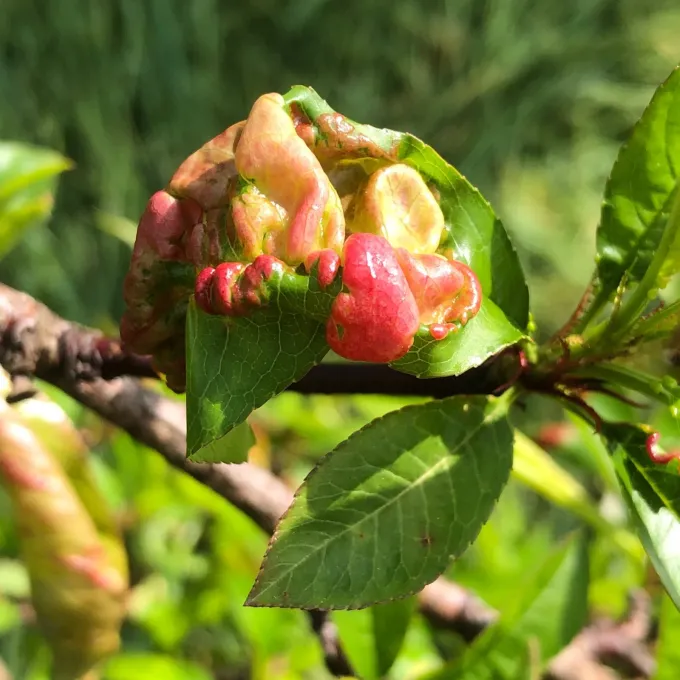
The first signs of peach leaf curl appear in early spring as new leaves emerge. The foliage becomes thickened, curled, and develops a characteristic red or purple puckering.
As the infection progresses, a dusty, whitish bloom appears on the undersides of the leaves. This bloom consists of fungal spores which serve as the primary source for further spreading.
Infected leaves eventually turn yellow or brown, become brittle, and drop prematurely. This process can lead to the near-total defoliation of the tree by mid-summer.
Shoots and twigs are also affected, often becoming stunted, swollen, and distorted. In severe cases, these branches may stop growing entirely or wither away under the stress.
Developing fruit can also show signs of the fungus, manifesting as wart-like growths that cause the fruit to crack and lose its marketability and flavor quality.
Pathogen
The causal agent of this disease is the fungus Taphrina deformans. It is an obligate parasite that specifically infects members of the Prunus genus.
The fungus overwinters as microscopic spores in the crevices of bark, on the surface of buds, and between bud scales, surviving harsh winter conditions.
Initial infection occurs when buds begin to swell in spring. If the weather is cool and damp, the fungus penetrates the young tissues and colonizes the expanding cells.
While the peach is the most significant host, this pathogen is also known to affect related species such as almonds, which is a critical consideration for orchard diversity.
Once the infection is established within the plant tissues, the fungus manipulates cellular division, creating the characteristic deformations seen on the foliage.
Conditions for development
The disease thrives during periods of cool, wet weather. Prolonged spring rains during the bud break period are the primary driver of epidemic outbreaks.
Optimal development for the pathogen occurs at temperatures ranging between 10 and 15 degrees Celsius. Higher temperatures typically inhibit the activity of the fungus.
Poor ventilation in the orchard, caused by dense planting or lack of pruning, increases the period of leaf wetness, providing an ideal environment for spore germination.
The timing of the weather is critical. If the weather warms up quickly after bud break, the risk of significant infection is drastically reduced.
In climates with high humidity and temperate springs, the disease is considered a major limiting factor for successful stone fruit cultivation.
Why it matters
Severe defoliation weakens the tree significantly, as it reduces the plant's ability to perform photosynthesis and produce energy for long-term health.
Repeated annual attacks force the tree to constantly expend energy to replace leaves, leading to severe nutritional depletion and increased susceptibility to winter damage.
Fruit set is heavily impacted, and trees may experience complete crop failure as energy is redirected toward recovering from leaf damage rather than supporting fruit.
The long-term impact of chronic infection is a stunted growth pattern and, eventually, the premature death of the tree after several years of unchecked disease.
Orchard productivity drops significantly, making the management of this disease essential for any sustainable commercial or private stone fruit enterprise.
Protection
The most effective strategy is a preventative fungicide application applied during the dormant season, specifically before the buds begin to swell in early spring.
Proper pruning is essential to improve airflow through the canopy, which helps leaves dry faster and reduces the duration of favorable conditions for fungal growth.
Removing and destroying infected twigs and fallen leaves during the growing season is crucial to minimize the fungal spore load for the following year.
Selecting resistant cultivars that are specifically bred to withstand Taphrina deformans can drastically reduce the need for chemical interventions in the orchard.
- Dormant season copper-based sprays.
- Sanitary pruning of infected shoots.
- Removal of fallen diseased foliage.
- Monitoring weather patterns for optimal spray timing.
In brief
6
Affects crops
Biology
Pathogens and affected parts
Pathogens
Affected plant parts
leaf
Content graph
Affects crops · 6
Content graph
Connections · Peach leaf curl
Most often together:
Marketplace
Products · 1
Community
Discussion
No discussions yet — be the first.