

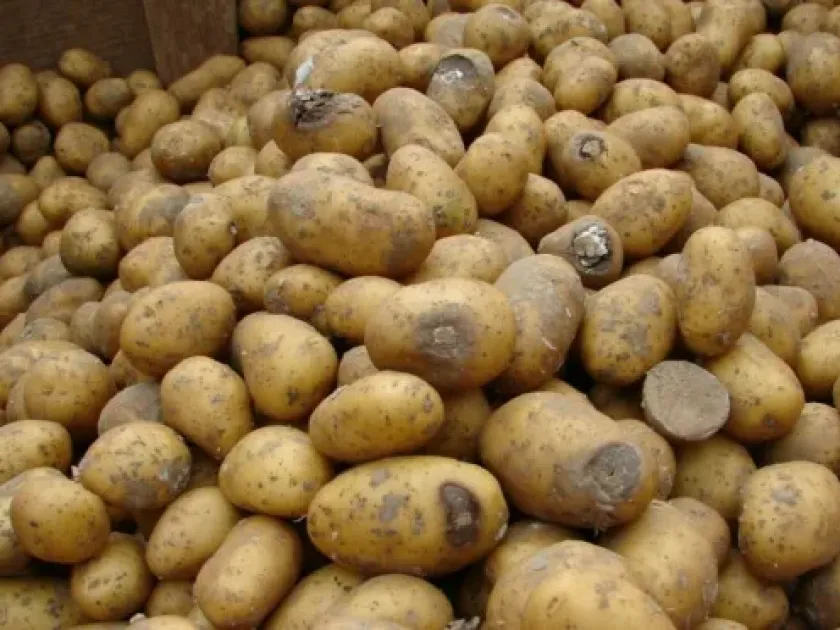
Description
Symptoms
The first symptoms appear as small, dark, depressed spots on the potato skin. As the disease progresses, these lesions expand, and the skin begins to shrivel, often showing characteristic concentric circles around the infection site.
Over time, the surface of the lesions may develop fungal sporulation in the form of white, pink, or yellowish tufts. These structures are the source of spores that further propagate the infection within the storage environment.
When an infected potato is cut open, a sharp contrast between healthy and necrotic tissue is visible. The internal tissue becomes dry and powdery, often leaving cavities filled with a dense, white, or gray network of fungal hyphae.
Plants affected in the field may show signs of yellowing, wilting, and premature senescence. The stems, when examined, often display a browning of the vascular tissue, indicating that the fungus has obstructed the plant's nutrient and water transport system.
Significant weight loss occurs in infected tubers due to transpiration and tissue destruction. Unlike soft rots, which are often accompanied by a foul odor and watery texture, dry rot remains relatively dry unless secondary bacteria colonize the tissue.
Pathogen
Fusarium dry rot is caused by the fungus Gibberella pulicaris (anamorph Fusarium trichothecioides). It is a persistent soil-borne pathogen that thrives in crop debris and survives for extended periods within the soil structure.
The fungus acts as a facultative parasite, meaning it can survive on both living tissues and decaying organic matter. Its life cycle involves the production of conidia, which act as primary inoculants, spreading through wind, water splash, and infested machinery.
Infection typically initiates via physical damage on the tuber skin. Cuts, bruises, and abrasions sustained during mechanical harvesting provide an easy access point for the fungal mycelium to penetrate the internal tissues.
Upon entry, the fungus secretes complex enzymes that degrade cell walls. This process leads to the enzymatic breakdown of the tuber, transforming the internal starch-rich environment into a dry, friable mass of fungal mycelium and decaying cells.
In storage facilities, the pathogen spreads rapidly if environmental conditions are not managed. The buildup of inoculum from single infected tubers can quickly lead to the infestation of the entire storage lot if sanitation protocols are ignored.
Conditions for development
High relative humidity (exceeding 80%) provides an ideal environment for the growth and colonization of the fungus. Storage facilities with poor ventilation frequently struggle to maintain the required dry microclimate, leading to disease outbreaks.
Temperatures ranging from 15 to 25 degrees Celsius are optimal for the pathogen. Rapid cooling of tubers following harvest is essential to slow down fungal metabolic processes and extend the shelf life of the product.
Mechanical injury during harvest remains the most critical factor for infection. Careful handling and the implementation of a proper curing period allow potatoes to develop a corky periderm (skin) that serves as a natural barrier against fungal ingress.
Condensation within storage rooms, often caused by poor insulation or temperature fluctuations, creates surface moisture on tubers. This moisture serves as an activation agent for dormant spores present on the skin of the potatoes.
Poor soil drainage in fields can also lead to pre-harvest infection. When soil is saturated, the lack of oxygen can weaken the natural defenses of the potato skin, allowing the pathogen to enter through the lenticels.
Why it matters
The primary harm caused by Fusarium dry rot is significant post-harvest loss. Entire stockpiles can be rendered worthless in a matter of weeks, leading to devastating economic impacts for agricultural producers.
Infected tubers are unsuitable for human consumption or livestock feed because they may contain mycotoxins. These toxins can cause severe health complications, rendering the entire lot unsafe for the market.
Using infected seed potatoes leads to poor crop stands. The fungus can inhibit sprouting or kill developing shoots before they emerge, directly reducing the potential yield per hectare and increasing production costs.
The persistent nature of the fungus in the soil complicates long-term crop rotation strategies. Once a field is infested, the pathogen requires extended fallow periods or specific rotation crops to reduce the inoculum level.
Management costs increase as producers are forced to invest in fungicides and improved infrastructure for storage. These added expenses often negatively affect the profit margins of the farming enterprise.
Protection
- Selection of potato varieties known for their resistance to Fusarium dry rot.
- Implementation of an effective crop rotation cycle lasting at least 4 years.
- Minimizing mechanical impact during harvesting to prevent skin damage.
- Properly curing potatoes in a dry, ventilated area for 10-14 days before final storage.
- Strict sanitation of storage equipment and the maintenance of a low, stable temperature (2-4°C).
In brief
1
Affects crops
Biology
Pathogens and affected parts
Pathogens
Affected plant parts
whole plant
Content graph
Affects crops · 1
Content graph
Connections · Fusarium dry rot
Most often together:
Marketplace
Products · 11


Community
Discussion
No discussions yet — be the first.