
Bacterial ring rot of potato
Clavibacter sepedonicus
Description
Symptoms
Symptoms often appear late in the growing season. The initial signs include chlorosis and wilting of the lower leaves, which eventually turn brown and become necrotic. The stems may also exhibit a slight, characteristic wilt.
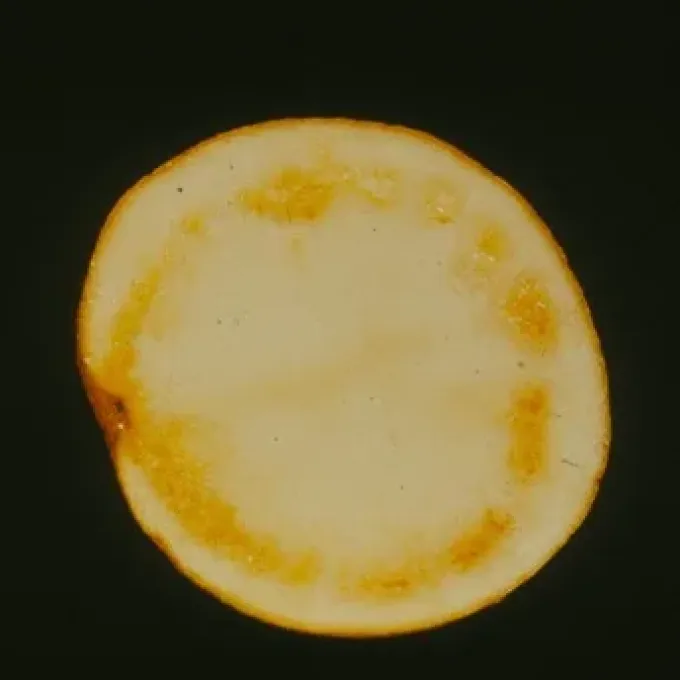
A cross-section of an infected tuber typically reveals a creamy, yellowish or grayish rot of the vascular ring. In later stages, this ring becomes soft and mushy, potentially forming a cavity in the center of the tuber.
In many cases, the symptoms remain latent, meaning the tubers appear externally healthy while the vascular tissues inside have already begun to degrade. This makes field diagnosis particularly challenging without specialized testing.
During storage, the disease progresses further. The tuber may lose its skin integrity, and in severe cases, the entire internal tissue collapses into a foul-smelling, cheesy, or slimy mass.
- Wilting and chlorosis of leaves starting from the margins.
- Vascular ring discoloration (cream or yellow tint).
- Soft, slimy decay within the tuber.
- Cracking of the tuber skin in advanced infection stages.
- Cavity formation in the center of the tuber.
Pathogen
The causative agent of the disease is the bacterium Clavibacter michiganensis subsp. sepedonicus. It is a Gram-positive, non-spore-forming bacterium that survives primarily in infected tubers, debris, and agricultural machinery.
This pathogen is specialized for colonizing the vascular tissues of solanaceous crops, with the potato being the most significant host. It lacks flagella, meaning it spreads through passive transport by moisture and plant sap.
Once inside the plant, the bacteria multiply within the xylem vessels. They secrete extracellular enzymes that break down the plant cell walls, leading to the characteristic yellowing and rotting symptoms observed in the field.
The bacterium is highly persistent and can remain dormant on wooden crates, handling equipment, and storage surfaces for extended periods. This makes sanitization an essential part of disease control.
Despite being sensitive to some environmental factors, the pathogen is remarkably hardy against cold temperatures. It can survive in infected tubers under storage conditions that would otherwise limit the growth of many other fungal or bacterial pathogens.
Conditions for development
Bacterial ring rot thrives in temperatures between 20°C and 25°C. High soil moisture and moderate humidity are conducive to the rapid systemic spread of the bacteria within the potato plant.
Mechanical operations, especially cutting seed tubers, are the primary drivers of field-to-field and plant-to-plant transmission. The knife becomes contaminated upon cutting an infected tuber and subsequently inoculates healthy ones.
Wounds caused by cultivation equipment, such as harrows or weeding tools, serve as entry points for the bacteria. Once the vascular system is breached, the pathogen moves quickly throughout the plant.
Humidity management in storage facilities is critical. Poor ventilation and high moisture levels trigger the secondary rot process, turning small infections into widespread tuber decay throughout the pile.
The pathogen is not known to persist in the soil for very long without a host, but the presence of volunteers (potatoes left from the previous season) can serve as a reservoir for the infection.
Why it matters
The economic impact of bacterial ring rot is severe due to its status as a quarantine pathogen in many regions. Detection of the disease often results in the immediate condemnation of entire seed lots.
Yield loss occurs not only through the direct rotting of tubers but also due to the premature death of the plant canopy. This reduces the tuber sizing and overall marketability of the remaining crop.
The disease undermines the integrity of certified seed potato programs. Because it can be transmitted through asymptomatic tubers, it can spread rapidly across a region before detection occurs.
It limits export potential, as international phytosanitary regulations strictly forbid the movement of potatoes from fields or regions known to harbor Clavibacter sepedonicus.
Furthermore, the cleanup costs are immense, involving the disposal of infected stock, sterilization of storage facilities, and potential fallowing of fields to ensure the pathogen has completely died out.
Protection
The most important control strategy is the use of disease-free, certified seed potatoes. Always source seeds from reputable suppliers who perform regular laboratory diagnostic testing.
Implement strict sanitation protocols for all equipment used in handling potatoes. Disinfect knives, harvesters, trucks, and storage bins using approved quaternary ammonium or bleach solutions.
Practice a crop rotation cycle where potatoes are not grown in the same field for at least 3–4 years. Ensure that all volunteer potato plants are destroyed between seasons to remove potential host reservoirs.
Minimize mechanical wounding of tubers during harvesting and processing. Avoid cutting tubers whenever possible; instead, use whole-seed potato planting to reduce the risk of mechanical transmission.
If the disease is detected, quarantine the affected fields immediately. Remove and destroy all infected plants and tubers, and perform a complete sanitation of the area before using it for future agricultural activities.
Discussion
No discussions yet — be the first.