
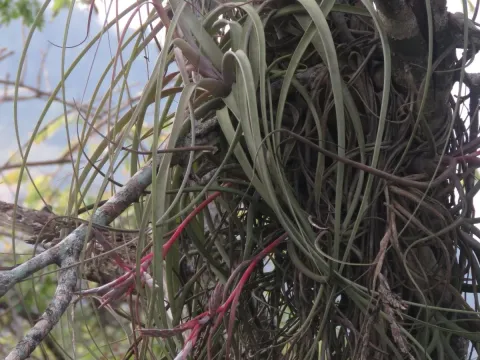
Tillandsia pseudobaileyi
Tillandsia pseudobaileyi
Tillandsia pseudobaileyi is a species of flowering plant within the Bromeliaceae family. Native to the tropical regions of Mexico and Central America, this plant is an obligate epiphyte that naturally thrives by clinging to the branches of trees in its native habitat.
What the section contains
Tillandsia pseudobaileyi
The plant is distinguished by its unique bulbous base, known as a pseudobulb, which provides structural integrity and water storage capabilities. The entire foliage is covered with trichomes, specialized cells that allow the plant to absorb atmospheric moisture and nutrients efficiently.
Cultivation of this species does not require traditional soil or potting media. Instead, the plant is typically mounted on driftwood, cork bark, or other porous materials. This method simulates its natural life cycle and ensures proper aeration, which is critical for the health of its rootless structure.
To maintain Tillandsia pseudobaileyi, it requires bright, indirect light exposure. High humidity levels, ideally ranging between 60% and 80%, should be maintained through regular misting or periodic soaking in non-mineralized water. Adequate air circulation is vital to prevent moisture accumulation.
The temperature range for optimal growth is between 18 and 26 degrees Celsius. Providing a stable environment without sudden fluctuations will encourage the plant to bloom, typically producing striking, colorful bracts that enhance its overall ornamental value in indoor plant collections.
Pests such as mealybugs and scale insects pose the most significant threat to the plant's health. These pests often congregate near the base of the leaves and within the pseudobulb, making early detection and manual removal or application of biological treatments essential.
Fungal rot represents a major physiological risk, particularly if the plant remains waterlogged for extended periods. To mitigate this threat, it is essential to ensure that the plant dries completely within four hours after watering, preventing the proliferation of pathogens that cause tissue decay.