
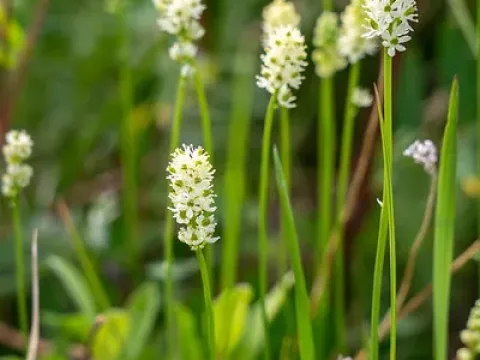
Tofieldia
Tofieldia
The genus Tofieldia belongs to the family Tofieldiaceae. These are perennial herbaceous plants primarily native to the cool temperate and arctic regions of the Northern Hemisphere, where they thrive in specific ecological niches.
What the section contains


Tofieldia
Tofieldia species are typically found in moist environments, such as fens, peat bogs, and along the edges of mountain streams. They often inhabit limestone-rich soils, which provide the unique mineral conditions necessary for their survival.
Botanically, the plants are characterized by a basal rosette of iris-like or linear leaves. The inflorescence is a terminal raceme of small, often greenish-white, yellowish, or sometimes pinkish flowers that appear on a simple stem.
The root system consists of short, creeping rhizomes. This structural adaptation allows the plant to persist in waterlogged soil conditions, providing stability while drawing nutrients from the nutrient-poor substrate typical of bog ecosystems.
While Tofieldia is not cultivated as a commercial crop, it is of interest in botany and ecology. It serves as a bioindicator of specific wetland conditions, demonstrating remarkable resilience to cold climates and challenging hydrological environments.